Showing posts with label painting. Show all posts

Wednesday, June 13, 2012

Spotlight on Vincent Van Gogh

Self-Portrait - 1889
Ears, shmears! Who needs them when you can paint?! Vincent Van Gogh certainly didn't. Well, at least he felt that he could do without part of his left ear, but what he could do with a paint brush was miraculous. This Post-Impressionistic painter is certainly one of the world's finest Master Artists and is the focus of this week's Budding Artists children's art workshop at the London Farmer's Market. The workshops are 90 minutes of fun, art history and a few lessons in technique in the vein of the master himself - Van Gogh. Let's take a look at what Van Gogh accomplished in his short 37 years.
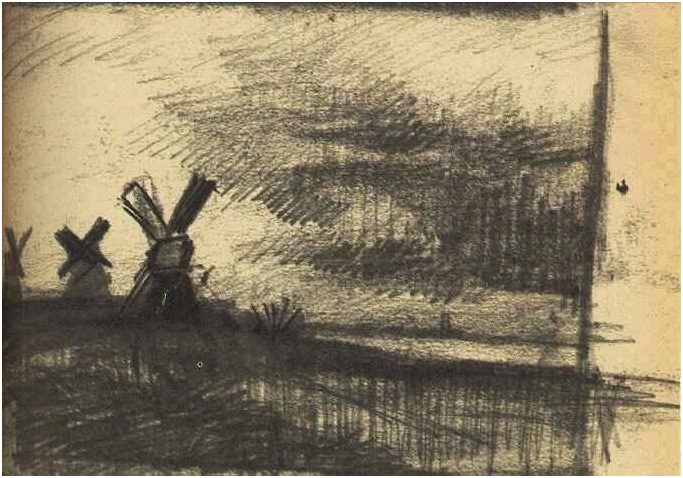
Windmills at Montmartre - 1877
Vincent Van Gogh was born in Groot-Zundert, the Netherlands on March 30, 1853. He was the son of a pastor, and hailed from a long line of artists and art dealers. He became interested in art at an early age, and flourished in Middle school when he received lessons in drawing from a successful artist there. By the time he was 20 years old, he had obtained a job as an art dealer in London, with the help from an uncle. One of the happiest periods of his short life, he sketched and drew in his extra time, when he wasn't dealing in Art. After being transferred to Paris in 1875, he fell on the outs with Goupil & Cie, the company he had been working for, and left them to return to London.
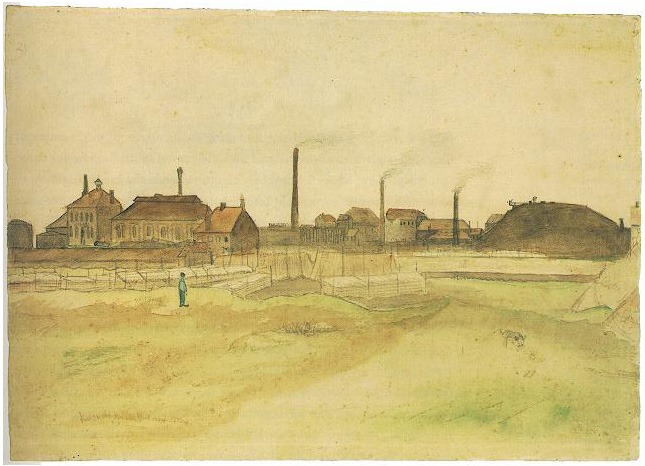
Coalmine in the Borinage - 1879
Disillusioned with the world of art dealers, Van Gogh turned to religion. He had always had a strong religious faith, but by 1876, he felt the urge to devote himself to the Church. He entered the school of theology in Amsterdam, but it quickly became apparent that he would not flourish in this path. He dropped out of school, then failed an admission test to enter a mission school in Laeken. Undeterred, he applied to a missionary post in Borinage and tried his hand at bringing religion to the people there. While his zeal was almost fanatical, the powers that be were not impressed. After only six months, they dismissed him from his post. Despite this, Van Gogh remained in the area for over a year, trying to help the residents of the impoverished area and himself, both living a life of poverty. Ultimately, via suggestions by his brother Theo, he left Borinage behind. With a failed marriage proposal to his recently-widowed cousin, he also left his religious faith as well.
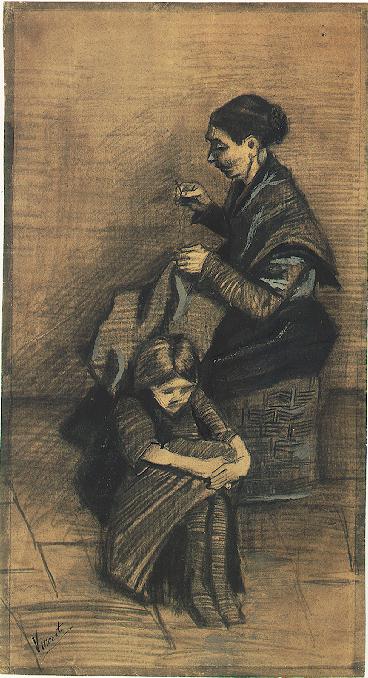
Woman Sewing,
With a Girl - 1883
It was at this point that Van Gogh reacquainted himself with his cousin Anton Mauve. Mauve introduced him to the world of watercolours and oils and ignited in him a new passion. With a career as Artist in sight, Van Gogh flung himself into this new occupation. It was at this time that he also met Clasina "Sien" Hoornik. An alcoholic, pregnant prostitute with a young daughter in tow, Van Gogh fell in love with his dear Sien. Their rocky relationship was marred by poverty and much fighting, but he was devoted to her children and often used Sien as a model. Van Gogh's family was not impressed though and they demanded he leave her. After spending three weeks in hospital, due to a case of syphilis and gonorrhea that he contracted from Sien, he was finally swayed.Van Gogh left her in 1883, after spending just over a tumultuous year together.
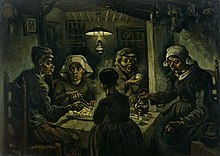
The Potato Eaters - 1885
Disheartened by another love lost, Van Gogh returned to his family's home in Nuenen and devoted himself once more to drawing and painting. He spent two years there, often-times sketching peasants. It was during this time that he painted one of his most famous works "The Potato Eaters", although it wasn't until long after his death that it received public attention. Struggling emotionally, financially, and artistically, he decided to move to Antwerp and studied the works of Peter Paul Rubens, as well as Japanese artwork. While his exploration of colour theory helped to broaden his colour palette, his locale only served to deteriorate his health. By 1886, Paris beckoned and Van Gogh moved in with his brother Theo.

Starry Night - 1889
The last few years of this troubled artist's life were incredibly productive, but also fraught with much strife. He lived with his brother Theo for most of the two years he was in Paris and during that time met the likes of Claude Monet, Camille Pissarro and of course Paul Gauguin. The bright colours that were rampant in the Impressionist movement influenced Van Gogh's own palette and suddenly his dark pieces disappeared, replaced by the bright colours that he is most famous for. The break from excess (drink, smoke, poor diet) that he hoped to achieve with a move to Arles, sadly did not improve Van Gogh's lot. While he continued to paint and draw, his health spiralled out of control. He committed himself to an asylum, but even that respite was not enough to save him. On July 27, 1890, the world lost an incredible artist, when Van Gogh shot himself in the chest. Two days later he was dead, from complications during his treatment. Despite the mental and physical illnesses that he struggled with throughout his life, he left behind a legacy of art behind. He painted nearly a thousand paintings, over a thousand drawings and sketches, as well as enough letters (mostly to his brother Theo) to document his incredible journey through life. While he only sold one painting during his lifetime, they now go for upwards of $100 million. Quite the feat, and one that has influenced a myriad of artists since then.

Perhaps its time that your child discovers the magic of this tragic master artist. See you June 16th!

Tuesday, May 1, 2012

Spotlight on Diego Rivera

Diego Rivera was born December 8, 1886 in Guanajato, Mexico. The son of school teachers, education was highly valued in his family. While attending Catholic school, he enrolled in the art program at the Academy of San Carlos. He originally attended evening classes there, but his aptitude for the arts was apparent and he became a full-time student two years later, in 1898. Rivera's first public exhibition of his work was held in 1906, which attracted enough attention that by 1907, the Governor of the State of Veracruz had sponsored Rivera to continue his studies in Europe.

Head of a Breton Woman - 1910
Rivera arrived in Europe during a time of great change in the art world. He originally studied with Eduardo Chicharra in Spain, then continued on to Paris, France. It was here that he embraced the up and coming artists of the day, including such notables as Amedeo Modigliani, Moise Kisling, Chaim Soutine, Max Jacob and gallery owner Leopold Zborowski. The Montparnasse district was full of Cubist influences, from the likes of Picasso and Georges Braque and Rivera soon found those influences affecting his own work. By 1917, the artwork of Cezanne also left an impression on Rivera and his artwork now showed signs of Post-Impressionism as well.

Creation (mural) 1922
While Europe left a huge mark on Rivera's art, his heart still belonged to Mexico and he returned to it in 1921. He had spent the past 14 years travelling throughout Spain, France and Italy, but with a more mature style, he found the need to reconnect with his home country and all that it offered. One of those things offered was the chance to leave a lasting public image via murals. At the time the government was pushing for education, equality and a recognition of their culture, which Rivera was perfect for. "Creation" was his first mural, but was just the beginning of his work with this medium, which was further showcased when he joined the Revolutionary Union of Technical Workers, Painters and Sculptors. He followed that up by joining the Mexican Communist Party later that year.

El Vendedor De Alcatraces
His association with the Communist Party was not an easy one though. Rivera was vocal in his political beliefs and often attacked the church and clergy, making him a controversial figure. Despite that, he was invited to visit Russia in 1927. After spending nine months there, he was asked to leave and left with very little to show for his time spent, aside from a few paintings and much disillusionment on both sides about the other parties. Non-plussed, Rivera continued to paint, this time embracing another land and culture, that of the United States.

Section of Detroit Industry - 1933
In 1930, Rivera arrived in San Francisco with his new wife Frida Khalo. The architect Timothy L. Pflueger had heard about Rivera from Ralph Stackpole and subsequently had encouraged him to paint for him in the USA. This proved a successful venture for Rivera and he painted many murals, including "Detroit Industry" at the Detroit Institute of Arts. He spent three years in the US, then returned to Mexico, after furors over his political beliefs. He returned once more in 1940, again by request of Pflueger, this time to paint for the Golden Gate International Exposition.

Over the span of Rivera's lifetime, he created many murals and many more controversies. He had many affairs, often torrid in nature, but his love for Khalo was the one constant at the end of his life. His relations with the Communist Party waxed and waned, but shortly before his death he was allowed to re-establish ties to the party. His beliefs affronted many, but his skill impressed more. And Budding Artists recognizes everything that he accomplished and will be featuring him in this weekend's Master Series Children's Art Workshop. So pack up your kids and ship them off to the London Farmer's Market on Saturday May 5th at 10:30am or 1pm, where they will enjoy 90 minutes of creativity, art history and fun with Budding Artists and famed Mexican artist Diego Rivera. A perfect activity for them to celebrate art and Cinco de Mayo too!

Tuesday, April 24, 2012

Spotlight on Joan Miró

“The painting rises from the brushstrokes as a poem rises from the words. The meaning comes later.” ~ Joan Miró

Joan Miró was born April 20, 1893 in Barcelona, Spain. Son of a goldsmith mother and watch-making father, he was encouraged to go into business at an early age. Miró was drawn to the arts though. He acquiesced by attending both business school and art classes at La Escuela de la Lonja. It proved to be the art that won out though. Leaving the business world behind,  Miró continued his art lessons and was rewarded by the first solo exhibition of his works in 1918 at the Dalmau Gallery.

The Farm -1922
With a taste of the art world, Miró decided to expand his horizons and visited Paris in 1920. It was here that he met Pablo Picasso and was introduced to the Cubist movement. He also met the likes of André Masson, Pierre Reverdy and Tristan Tzara, who would come to be his friends, confidantes and influential on his artwork over the years. His earlier Fauvist style, now showed signs of these influences and by 1921, he had the first exhibit of his works in Paris, at the Galerie la Licorne.

Carnaval de Arlequin -1924
Miró was never one to settle into a rigid style though, so as time marched on, so too did his artwork. He divided his time between Paris and Spain, drawing on his Catalan roots, Fauvism, Cubism, and gradually showing an influence from Surrealism. In fact, by 1924 he joined the Surrealist group and exhibited with them at the Galerie Pierre in 1925.

La Femme Angora - 1969
This change in style saw Miró drifting away from traditional mediums and start exploring other art forms. He began experimenting with collage on almost any surface he could get his hands on, including paper, copper and sandpaper. He tried his hand at lithography, etchings and painting other surfaces, such as stones and other found objects. He pulled away from the very idea of the frame that surrounded a painting in fact and while subject matter could still be found in his work, landscape was gone.

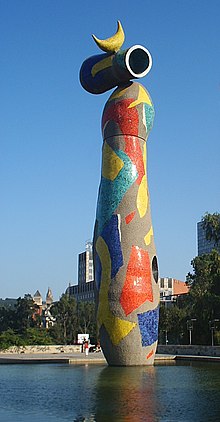
Dona i Ocell - 1982
While Miró embraced more sculpture and public works in his later years, he is credited with painting over 2000 oil paintings, 5000 drawings and collages, 500 sculptures and 400 ceramics. It wasn't until the 40s that he started working with ceramics, but by the 60s his focus turned to sculpture. His monumental achievements were recognized by galleries and museums around the world, including the Guggenheim.

For this reason, and so many more, he is the focus of this week's Master Series Children's Art Workshop held by Budding Artists. Join us for 90 minutes of fun, history and a dash of creativity as we explore the Surreal world and works of Joan Miró. Workshops are held at the London Farmer's Market in London, Ontario at 10:30am and 1pm. Contact Budding Artists today to reserve your child's spot!

Monday, April 16, 2012

A Point About Georges Seurat

"Some say they see poetry in my paintings; I see only science." ~ Georges Seurat

Shall we get straight to the point today? We are talking about Georges Seurat. He was a French painter. He was born on December 2, 1859 and he revolutionized the art scene with his new fangled approach to art called Pointillism. In his short 31 years on the planet, he painted over 60 canvases, filled many sketchbooks full of drawings and was instrumental in ushering in Neo-Impressionism. Sadly, he passed away March 29, 1891, but left behind some of the most impressive examples of artwork that exemplified his interest in colour, linear movement, and indeed the science behind art as a whole.

Bathers at Asnières
So what exactly is pointillism and how did Seurat introduce it to the world? While Seurat was encouraged to pursue his artistic interests via relatives, and attended the École des Beaux-Arts from 1878-1879, it wasn't until he struck out on his own that his art blossomed. He discovered the Impressionist painters of the day and realized that he did not have to be limited by rigid academic dictates. It was at this point that he began studying colour, light and began experimenting with tiny brush strokes that evoked a bigger picture when looked at from afar.

The Gardener
In fact, the more that Seurat studied the science behind vision and colour, the more he developed his own style. He used tiny dots of colour, to form his paintings and in such a way added immense depth to his canvases. By 1884, he helped to found the Société des Artistes Indépendants, with artists such as Maximilien Luce and Paul Signac. Signac was to become a good friend of Seurat's and ultimately followed in his artistic footsteps. By the time the two artists exhibited their work in Brussels in 1887, alongside other artists who were also using a pointillist style, they decided to form a new group and called themselves Neo-Impressionists.

Young Woman Powdering Herself
While Seurat continued to paint, disagreements between members of the newly formed Neo-Impressionist movement soon found him withdrawing from the formal group. He met Madeleine Knobloch in 1889 and became smitten with the young, simple woman (who is the model for Young Woman Powdering Herself). The two had a child together, but Seurat suddenly became ill shortly thereafter. He left an unfinished painting ("Circus"), as his last piece before his death. His infant son died shortly thereafter, probably of the same illness (unproven, but quite possibly their deaths due to diptheria). What was not lost though, was a new style of painting that influenced the likes artists to come, such as Van Gogh, Gauguin and Lautrec.

Budding Artists hopes to influence a whole new generation of artists this Saturday April 21st at the London Farmer's Market during our weekly children's art workshop. Georges Seurat will be our Master Artist to explore, as children learn a little art history, have a lot of fun and get to bring home their very own Seurat-inspired artwork made by themselves. Workshops are held at 10:30am and 1pm and run for 90 minutes, so register today to make sure your child gets to enjoy artwork with a point.

I offer you a moment to enjoy and explore one of Seurat's most famous paintings "La Grande Jatte", set to music. Can you remember what movie this famous picture was featured in and who got lost in the little girls face?


Wednesday, April 11, 2012

Impressions of Claude Monet

Inviting meadows, serene ponds and idle women relaxing in reverie are all images that were caught by the deft hand and delicate impressions from one of France's most renowned painters, Claude Monet. Born in Paris, France on November 14, 1840, Monet was destined to become a Master Painter. By the age of five, his family moved to Le Havre, where he began to show interest in the arts. While his father encouraged the young Monet to go into business, his mother supported his artistic endeavors, so by the time he entered secondary school he was already well versed in drawing caricatures of his fellow students and teachers. With lessons in drawing, from Jacques-Françoise Ochard, his skills further developed, setting him firmly on the path of the life of an artist.

The Rock Needle
And The Porte D Aval
 
Always preferring to be outdoors, when the young artist met Eugène Boudin in 1856/7 it proved to be providential. Boudin encouraged Monet to paint outdoors or "en plein air", and this style of painting stayed with him throughout his life. Boudin also introduced the use of oils into Monet's repertoire and soon landscapes began to appear in his paintings as well. While the death of his mother devastated the young Monet in 1857, it also propelled him forward in his career. Shortly thereafter, he moved back to Paris and met the likes of Édouard Manet and Camille Pissarro, both of which were to become friends and influencers of his art.

Impression Sunrise
Between 1861-2, Monet joined the military and served in Algiers. Due to poor health, he was discharged from service and returned to Paris, where he began studying under Charles Gleyre. It was during this time that he met Auguste Renoir, Alfred Sisley and Frederic Bazille, fellow painters that would prove to bring a new style of painting to the art world. With rapid brush strokes and a focus on lighting, which could often only be achieved by painting outdoors, these influential artists were to become the founders of the Impressionistic movement.

Camille aka
The Woman in a Green Dress
Long before the world hailed Monet as a Master Artist, he faced many struggles. While he gained a measure of fame when he had a few pieces selected by the Salons in Paris, a lack of financial stability and depression threatened to erase this budding artist. In 1870, he married Camille Doncieux, who had been a long-time model for many of his portraits. The outbreak of the Franco-Prussian war forced the newlyweds to flee to England, then the Netherlands, before returning to France in 1871. While his connections in the Impressionist movement grew, the health of his wife failed, and in 1879, Camille died of tuberculosis.

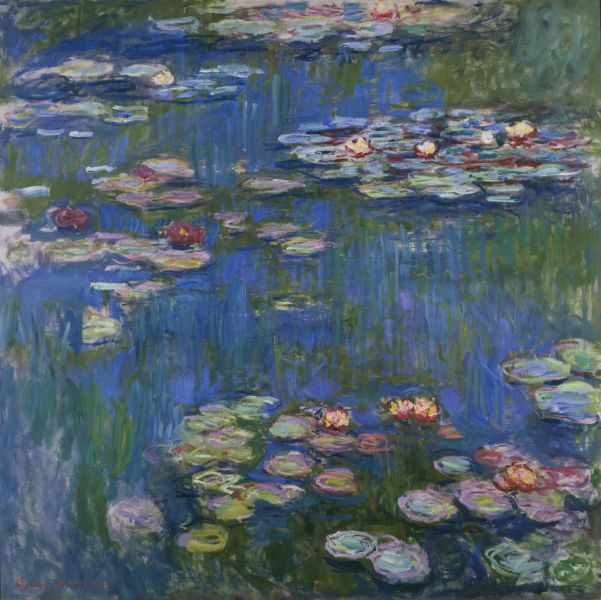
Water Lilies - 1905
Monet was devastated by his wife's death, and vowed to never again live in poverty. He threw himself into his work, entering the most productive phase of his life. He continued to paint en pein air and created magnificent landscapes and still lifes of everything from haystacks to water lilies, some of which today are now worth into the millions of dollars. He made Vétheuil home for a number of years, until he discovered Giverny. It was in Giverny where he finally bought himself a property that allowed him the luxury of painting to his heart's content in his very own gardens long into his years. Despite failing health and vision, this prolific artist painted up to his death on December 5, 1926.

On Saturday April 14, at the London Farmer's Market, you too can be swept away by the light of this Impressionist painter. Claude Monet will be the featured Master Artist in the first session of Budding Artists third Master Series Art Workshops for children. Register your child now for either the 10:30 am or 1pm workshop and expect them to have fun exploring art history, games and of course artistry, as they create their own masterpiece to take home with them. See you then!


Tuesday, April 3, 2012

The Subject I Know Best: Frida Kahlo

Meet Frida Kahlo, born July 6th, 1907 in Coyoacán, Mexico. This Mexican artist is well known for her surrealist paintings, but most especially for her self-portraits. Plagued by troubles throughout her life, she still managed to paint 143 paintings of which 55 of those were self-portraits. As she was often bed-ridden, she was
"...the subject I know best",
hence finding herself so often among her portrayals. What was it about her life that led to her inward eye though? Let's take a look...

Self Portrait -1926
Kahlo was a young girl at the start of the Mexican revolution (began 1910) and as such, was often exposed to the violence that occurred outside her door. The "Blue House", her childhood home and residence later in life, may have protected her from some of the ills of war, but it could not protect her from illness, and at the age of six she developed polio. While she survived, Kahlo was to bear the scars of her illness in the form of a thin and stunted right leg. She learned to cover up this deformity, but tragedy was to strike again. On September 17, 1925 Kahlo was in a serious bus accident that left her bedridden for upwards of a year recovering from multiple injuries, that included a fractured spine and collarbone, broken ribs and pelvis, as well as multiple injuries to her right leg and foot. Sadly, her uterus was also damaged in the accident, meaning that at the age of 18, she was humbled by the knowledge that she would never have the opportunity to bear children.

What the Water Gave Me
As doctors questioned whether Kahlo would live, she herself refused to give up. She underwent over 30 surgeries, but took the time while she was recovering to delve into a new talent, that of painting. With her dreams of medical school behind her, she refocused on her artistic endeavours and began to paint portraits of herself, family and various friends. The colour and form were derived from her Mexican roots, but the style was all her own.

Self Portrait - 1940
It was via her budding artistic career that she met Diego Rivera, a well-known local muralist. Despite their difference in size (he was 300lb and she a mere 98lb) and age (he was 20 years her senior), they found themselves quickly entwined and by 1929 they were married, despite her mother's disapproval. While their original interest in art and communism drew them together, their differences made for a volatile union. Both of them had extra-marital affairs (Kahlo with both men and women), that brought them to divorce each other in 1939. It would seem that the old adage of "can't live with 'em and can't live without 'em" was in evidence for this couple though and they remarried again in 1940.

The Love Embrace of the Universe,
the Earth (Mexico), Me,
and Senor Xolotl
Throughout her pain-riddled life, Kahlo turned to the easel to help her through the turbulence. Her personality was large and flamboyent, as was so often portrayed on her canvases. She drew on images from her Mexican culture, as seen in the variety of monkeys, birds and brightly coloured flowers that graced her paintings. Often enough, her brooding eyes were the first draw for the viewer though. While she had various showings of her work in the USA and Europe, it wasn't until 1953 that she had her first exhibition of her work in her native land. While time would bring more fame to this spunky Mexican artist, her life was cut short by her death on July 13, 1954.

This weekend, Kahlo's fame lives on as Budding Artists features her in their Children's Art Workshop at the Western Fair Farmer's Market. Register your child today for either the 10am or 1pm 90-minute workshop, so that they can explore her style while creating artwork all their own. See you then!

Monday, March 26, 2012

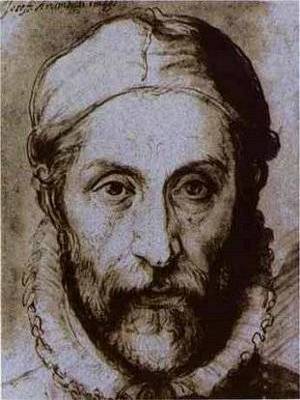
A Portrait of Giuseppe Arcimboldo

From the mind of a master, comes the fruits of his labours. And the books, flowers, roots and whatever other appropriate objects that captured the essence of the portraits painted by Giuseppe Arcimboldo. This imaginative painter was born in Milan in 1527 and was highly popular in his day. While falling out of favour during later art periods, Budding Artists revives this Italian Painter today in our newest look at a Master Artist for our weekend Art Workshops for Children at the London Farmer's Market in the Western Fair District. If you haven't brought your children by for one of the fun and educational workshops at either 10am or 1pm, perhaps 90 minutes of fruit-filled art history and creation,  inspired by Arcimboldo, will be just the thing!

Air
While the name Arcimboldo might not immediately ring a bell, his artwork surely does. This gifted painter lived during the High Renaissance period and was admired by his peers and royalty alike. He was the son of Biagio Arcimboldo, who was also an artist in his own right. Like his father before him, he began his career in stained glass, but it was Arcimbolodo's portraits that caught the eye of the courts that would support him for most of his life.

Winter
After studying under Leonardo Da Vinci, in 1562 Arcimboldo was called to the Royal Courts by Emperor Ferdinand I. His position as court portraitist became questionable when Ferdinand  died shortly thereafter, but the following emperor, Maximilian II, admired his caricatures as well and kept him on. He became an important royal architect, engineer, and stage designer for the many gala events that he oversaw, in which he designed costumes, props and other decor items like hydralic machines. His skill was so appreciated that when Rudolf II took over from his father Maximilian in 1576, he was again kept on in this position.

Vegetables
And what was it that kept Arcimboldo in the employ of the Royal Courts of Vienna, and then Prague, for over 25 years? Undoubtedly, it was his unique and spirited style of portraiture. Arcimboldo created bold oil paintings of court figures and other personages, that when viewed up close could be recognized as depictions of fruits, vegetables, animals, and a variety of other items. The theme of the painting dictated the objects that it was created from. For example, his series on the Four Elements drew images appropriate for each one; ie. "Air" is made up of a variety of birds that form a face. Likewise, his series on the Four Seasons used images that could be found during that season; ie. "Winter" contains tree roots and bare branches. He also utilized the art of optical illusions, like in the portrait of a bowl of vegetables, that when turned upside down, can be recognized as the picture of a man.

Vertumnus
With a long and illustrious royal career behind him, in 1587 Arcimboldo was finally allowed to return to his native Milan. Despite no longer being officially employed by emperor Rudolf II, in 1591 he painted perhaps his most famous portrait "Vertumnus" and dedicated it to him. The portrait was appreciated as much then, as it is now and was to be his last known painting. On July 11th, 1593, Arcimboldo died at home in Milan. While many of his paintings were lost to the world after the Thirty Years' War, enough of them remained to influence the likes of Joos de Momper, Pablo Picasso, Rene Magritte and of course Salvador Dali.

This week, Budding Artists hopes that we can tempt you to be influenced by the artwork of Giuseppe Arcimboldo too! Contact us today to register your child for our Children's Art Workshop on March 31st!

Monday, February 6, 2012

Spotlight on Amedeo Modigliani

This week's Artist spotlight is on the tragic figure of Amedeo Modigliani. His short life spanned the years from July 12th, 1884 through January 24th, 1920. Born in Livorno, Italy, he was the son of Sephardic Jews and came from a long line of intellectual scholars. Often sickly as a child, his mother tutored him at home for much of his younger years. It wasn't until 1898 that he began his formal training with Guglielmo Micheli, under which his interest and skill flourished.

Reclining Nude
Modigliani spent two years studying the Macchiaioli style (Italian landscape movement that pre-dated the French Impressionist movement) with Micheli, before taking ill with typhoid fever, which only got worse when he developed tuberculosis. During this time he lamented the thought that he would not get the chance to see the works of the master Renaissance artists in person. His mother promised that upon his recovery she would fulfill his dreams and to her word she was good. When he sufficiently recovered, they toured through Naples, Capri, Rome, Amalfi, Florence and Venice, where young Modigliani got a new artistic lease on life. By 1902, he enrolled in the Scuola Libera di Nudo in Florence, where his real artistic passion lay - portraiture, more specifically nude portraits. After a year, he transferred to Venice, where he continued his studies, but was introduced to a life that ultimately would be his demise, that of drugs and alcohol. It seemed a natural step at that point for him to make the move to Paris and in 1906 he arrived in Montmartre.

Stone Head
Life in Paris was nothing, if not exciting. Modigliani threw himself into his art, sometimes producing upwards of a hundred sketches per day. He was heavily into drugs, alcohol and whatever other excesses he could get into, in part to mask the symptoms of his tuberculosis. After returning home in 1909 for a brief respite from his life of excess, he returned to Paris and settled in Montparnasse. It was at this point that his main focus turned to sculpture and he spent the next five years creating art out of whatever materials he could get, namely scavenged building materials from Paris's building boom. He continued to live a bohemian existence that saw him usually intoxicated and/or in the company of the women he loved to depict so often. The outbreak of World War I made building materials harder to come by though and with his worsening physical state, Modigliani returned to painting as his medium.

Jeanne Hbuterne, Left Arm Behind her Head 
During the last years of his life, Modigliani created some of his most remarkable paintings. His life of excess continued, but so too did his creativity. He created distinctive paintings of children, in part due to the fact that he had become a father himself. Jeanne Hbuterne, the mother of his daughter, moved with him to Nice, when wartime made life in Paris too difficult . They returned to Paris in 1919, but by that point Modigliani's health had deteriorated to dangerous levels. He continued to drink, do drugs and paint, but there was little to conceal his ill health. In early January 1920, Modigliani took to his bed and the doctors announced there was nothing to be done. His tuberculosis finally caught up to him, and on January 24th, 1920, the young artist died. Sadly, Hbuterne was so distraught by his death that she took her own life, and in the process, the life of her unborn child.

On Saturday February 11th, Budding Artists will take a look at this Master Artist in our Children's Art Workshops at the London Farmer's Market. Join us at 10am and 1pm, as we look at this talented artist who created incredible portraits, sculptures and more in his few short years. There will be 90 minutes of art history, games, creativity and fun, as we explore this next artist in our Masters Series - Amedeo Modigliani.

Monday, January 30, 2012

Spotlight on Henri Rousseau

Self Portrait Of The Artist With A Lamp
Today, Budding Artists is thrilled to introduce Henri Rousseau. This French Post-Impressionist painter was born May 21st, 1844 in Laval, France. He was the son of a tinsmith and familiar with hard economic times during his early years. After the death of his father in 1868, he moved to Paris and became a government official. His position as tax collector enabled him to support his widowed mother,wife, family of six children and himself, although it left little time for artistic endeavors. In fact, it wasn't until he was in his forties that he turned to painting as a form of expression.

Sleeping Gypsy
So when Rousseau did finally embrace the life of a painter at the turn of the twentieth century, he came to it without any of the formal training that so many of his peers enjoyed at that time.  Hence, while he displayed many of his paintings in the Salon des Independants, he was often the focus of regular criticisms from the artists of the day. There were many that considered his artwork primitive and naive, but that did not prevent him from creating over 100 paintings, as well as influencing a whole new generation of artists.

The Snake Charmer
In fact, Pablo Picasso was said to have come across some of Rousseau's paintings being sold on the street, only to seek out the artist to meet with the genius behind them. Rousseau was also commissioned by artist Robert Delaunay's mother to paint "The Snake Charmer". And it seemed more than chance that his paintings were displayed near Matisse in what has since become known as the first showing of the "Fauves".

Tiger in a Tropical Storm Surprised
Throughout Rousseau's career, jungle scenes often dominated his canvases. This coming Saturday, February 4th Budding Artists will look at these scenes and many others to get a better look at the style and skill of this Post-Impressionistic painter. Through 90 minutes of games, art history and hands on practice, we will be running the next in our Masters Series of Kids Art Workshops at the Western Fair Farmer's Market at 10am and 1pm. Contact us today to book a space for your child to explore this vanguard artist.

Monday, January 23, 2012

Spotlight on The Group Of Seven

Algoma Sketch II - Lawren Harris


It is almost impossible to think of the Canadian art scene and not immediately have the Group Of Seven come to mind. Iconic images of the Canadian landscape form the backdrop to this incredibly successful group of artists that changed the face of art and Canadian's place in it. In fact, the Group of Seven heralded Canada's first National art scene via the creativity from seven Canadian painters that are still cherished to this day. And who were the first members of this distinguished group? None other than Franklin Carmichael, Lawren Harris, A.Y. Jackson, Franz Johnston, J.E.H. MacDonald, Arthur Lismer and Frederick Varley.


Autumn Foliage - Tom Thomson
The founding gentlemen of the Group of Seven began to meet around 1913 in Toronto, Ontario. Another artist by the name of Tom Thomson joined these original members in discussing their painting and art theories. They began to meet at a studio in Rosedale and travelled throughout Ontario sketching landscapes. Algonquin Park, Algoma and the Muskoka region were favourite locations and inspired the vast majority of the artist's brushes. Sadly in 1917, Thomson died in a mysterious accident doing one of the things that he loved best: canoeing in Algonquin Park.


The White Pine - A.J. Casson
While this loss, along with the disruption from World War I, temporarily prevented the group from moving forward, the artists were not deterred. They reunited after the war and by 1920 officially labelled themselves as the "Group of Seven" and launched their first public exhibition. With the unwavering support from the National Gallery, these fresh new artists challenged the art scene of the day, introducing hitherto unfashionable landscape scenes. It was also at this time that Frank Johnston left the group, to be replaced by A.J. Casson.


Northern Tundra - Franklin Carmichael
Over the next decade, the Group of Seven gained in strength and breadth. They expanded their inspiration area, moving into landscapes across Canada from British Columbia to Quebec, Nova Scotia and even the Arctic. Their influence permeated the Canadian art scene and drew attention from other artists such as Emily Carr, Edwin Holgate and LeMoine Fitzgerald. By 1932, the members felt that it was no longer necessary to continue as a group and formerly disbanded. A new group, called the Canadian Group of Painters, was formed encompassing a wider range of artists, but still maintained the Group of Seven's original appeal and skill.


The Red Maple - A.Y. Jackson
Over the 13 years that the Group of Seven existed, this collection of intrepid artists challenged a fledgling art scene of a new nation. Where landscapes had previously been disparaged by Canadians, these forward thinking painters rebelled against the conservative art scene that previously had its focus on imitating other art styles. They took the Canadian landscape and pushed it into a revered spot, where nature was the ultimate canvas. Their influence to the Canadian art scene was so complete, that today they are considered the pinnacle of the Canadian image and examples of their paintings can be found in almost every art gallery across the country.


A September Gale Georgian Bay - Arthur Lismur
This coming weekend, Budding Artists will be taking an indepth look at the style and colours that helped to define these landscape artists as distinctly Canadian. Join us Saturday January 28th at 10am or 1pm for 90 minutes of art history, games, and fun at the Western Fair Farmer's Market, as we focus on the distinctly Canadian style from our Master Artists of the week: the Group of Seven.

Call today to book your child's spot!