Showing posts with label Cubism. Show all posts

Monday, June 25, 2012

A Look at Sculptor David Smith

We are into the last week of June and that means that this week will be Budding Artists last children's art workshop at the London Farmer's Market. We love our space and hope to return in the fall. If you haven't had a chance to attend previous art workshops, this weekend is a must! Workshops are held Saturdays at 10:30am and 1pm, running 90 minutes of fun and creativity. Children learn about the featured artist, discover a little art history, and get the chance to create some take-home artwork in the style of said artist. The kids always leave happy and you parents get a break for 90 minutes to do whatever you need or want to do! Register today! And as far as next year goes, you will certainly be the first to hear about what we have planned for the 2012/2013 Budding Artists schedule!

September might seem like an awfully long wait to keep your kids interested in art though. If you are worried about how to keep your children entertained this summer, note that Budding Artists will be hosting two week-long summer art camps this year. Back by popular demand, Maria Calleja and Nancy Clarke will be inspiring your children to reach to the stars with their artistic endeavours. Barb McGill will also be joining the Budding Artists team to add a little musical inspiration to the weeks. The summer camps run the weeks of July 23-27 and August 27-31, 2012, between the hours 9am-4pm. This year the camps will be held at the Wesley Knox Church at 91 Askin St., so contact Budding Artists today to secure your child's spot.

Ah, but we haven't mentioned who our featured master artist will be for this weekend's Children's Art Workshop yet! I will keep you in the dark no longer. This week, sculptor David Smith will grace your children with his influence, as they discover his many metal works. A man of little formal training, he still managed to climb his way to the top of the art world and is now considered one the most important sculptors of his generation. And it all began on March 9th, 1906 in Decatur, Indiana.

Reclining Figure - 1933
Smith entered the world with nothing earth-shattering to inspire his artistic creativity. His mother was a teacher and his father managed a telephone company, while on the side fashioned himself an amateur inventor. He moved with his family to Ohio in 1921, where he graduated from high school. He attended Ohio University in 1924-25, but dropped out of the University of Notre Dame the following year after only two weeks, due to the lack of any art classes. He spent the summer working at the Studebaker automobile factory, getting exposed to the materials that he would ultimately come to use most during his later artistic career. That career got its foothold when he moved to New York in 1926.

Head - 1938
Where art had always held an interest for Smith, it wasn't until he settled into life in New York that he was able to fully explore this medium. He became a member of the Art Students League of New York, where he met his soon to be wife Dorothy Dehner. He studied painting and drawing from artists John Sloan and Jan Matulka. It was through these painters that he was introduced to the artwork of Julio González, Willem de Kooning, Mondrian, Kandinsky and most notably, Picasso. While he never received any formalized education in sculpting, Smith absorbed all that he was taught and took the leap to realize that the only difference between sculpture and painting was the third dimension. It was this leap that he now took, when he began to forge sculptures out of metal and other found materials.

Hudson River Landscape - 1951
In 1929, Smith and his wife bought a run-down farm in Bolton Landing. A small art community there had enchanted them and by 1932, Smith had bought a forge and anvil for the studio at their summer home. Around the same time, he began renting out a space in a Brooklyn welding shop (Terminal Iron Works), where he began creating relief plaques and increasingly abstract sculptures. In 1938, he was honoured with his first one-man show of his drawings and sculptures at Marian Willard's East River Gallery. By 1940, he had tired of the New York art scene, so permanently relocated to Bolton Landing and renamed his studio after the welding shop he had left behind. Ironically, it was at this time that his artwork began to receive more notice, as he had a travelling exhibit featured by the Museum of Modern Art and the Whitney Museum of American Art. The outbreak of World War II found him neglecting his new found art though, as he took a job welding at the American Locomotive Company.

Cubi XVIII, Cubi XVII, Cubi XIX - 1963-64
With the war over, Smith had an outpouring of creativity. He took the skills he had learned welding, and devoted himself full-time to his art. His stint at teaching with the Sarah Lawrence College gained him the further respect he desired. That was followed by the Guggenheim awarding him two Fellowships, which meant that he could financially continue to focus whole-heartedly on his artwork.

During the '50s, with his increased recognition and financial means, his artwork began to grow in scale. He experimented with new drawing techniques and began to construct numbered series that continued til the end of his life. Sadly, his was a life cut short, as he died in a car accident in 1965. Over his 59 years though, he managed to create a new style of art through his metal- work that took Cubism and Surrealism to a new height. Never before had any American artists created work like his, but that legacy did not die with him (Artist Anthony Caro was directly influenced by Smith's work). In fact, exhibitions of his work are still on display around the world. And of course Budding Artists will be resurrecting him this weekend as well at our last children's art workshop of this session. Please join us!


Tuesday, June 5, 2012

Louise Nevelson: Sculpting Her Vision of Art

"I believe in my work and the joy of it. You have to be with the work and the work has to be with you. It absorbs you totally and you absorb it totally. Everything must fall by the wayside by comparison." ~ Louise Nevelson

And in this vein Louise Nevelson led her life. Over the 88 years that she walked the earth, she worked at creating her own unique version of artwork and was absorbed by it every step of the way. Born September 23, 1899 near Kiev, Russia, Nevelson's life began in a rocky way. Her father Isaac emigrated to the United States in 1902, leaving young Nevelson and the rest of the family behind. Once he had established himself in the lumber industry in Rockland, Maine, the rest of the family relocated in 1905 to join him in the USA. While these stresses brought the family closer together in some ways, they did not make for an easy beginning for Nevelson. That was not enough to keep this up-and-coming artist down though.

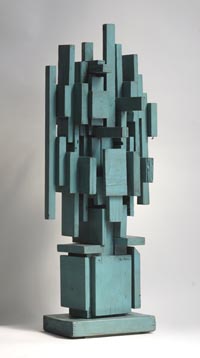
Untitled - 1950
When Nevelson came across a plaster cast of Joan of Arc in the Rockland Public Library at the age of nine, she knew that art would be a part of her life forevermore. She began her art career by studying drawing in high school. In 1920, she married Charles Nevelson and moved to New York, where she further studied painting, drawing, singing, acting and dancing. From 1929-30, she studied at the Arts Student League under Kenneth Hayes Miller and Kimon Nicolaides. When her husband moved the family out of the city, she became disillusioned with marital bliss and by 1932 she separated from her husband. Recognizing the importance of this focus on herself, Nevelson flew to Europe to further explore different styles of art. While there, she studied under Hans Hofmann in Munich, as well as worked as an extra in films in Vienna and Berlin.
Sky Cathedral - 1958

Nevelson returned to the US in 1932, where she once again studied with Hofmann. She was introduced to Cubism and collage, which influenced her greatly throughout her career. The following year she met Diego Rivera and worked as an assistant to him on his "Portrait of America" murals. The further she delved into the art scene, the more she embraced a style that was all her own. She began to teach mural painting at the Works Progress Administration in 1935. Despite this, money was tight. Perhaps because of this, the materials she collected for her sculptures were often found pieces, like castoff lumber.

Royal Tide 1 - 1960
It wasn't until 1941 that Nevelson had her first solo exhibition, held at the Nierendorf Gallery. While this helped to bring attention to her Modernist sculptures, success was still slow in coming to her. By the 50s, her reputation had grown and the Museum of Modern Art purchased one of her Sky Cathedral pieces. She travelled to Latin America and the Mayan artwork she came across was soon evident in her newest creations as the decade came to an end, with gold and white taking over from her previous all black pieces.

Dawn's Landscape XXIV - 1975
Finally achieving the fame she sought, the size of her pieces grew into monumental displays. Nevelson's name became synonymous with sculpture, but she also became a figurehead in women's art as a whole. She  challenged the idea that only men could become great artists. The fact that her estate was worth over $100 million when she died in 1988, seems to support the fact that women too could crack that gender bias.


Tuesday, May 15, 2012

Inspiration: Picasso

Pablo Picasso


The man was a Master Artist. He was a legend that changed the face of art. He influenced the likes of Piet Mondriaan, Diego Rivera, Joan Miró and a whole host of other artists during his lifetime and beyond. His style spanned Cubism and Surrealism, and he worked in such mediums as oils, ceramics, sculpture, copperplate etchings and more. He challenged the art world that he was born into and constantly morphed his style until he died in 1973 at the age of 91 years old.

Budding Artists will be featuring Pablo Picasso this Saturday, May 19th, 2012 at the London Farmer's Market during our Master Series Children's Art Workshop. Workshops are held at 10:30am and 1:00pm, and run 90 minutes in length. Children, aged 5-12 years, will get a chance to learn some art history, discover art techniques that Picasso favoured and take home their very own Picasso-esque artwork made by themselves. What better way to inspire creativity in your child than by learning about how the Masters have made it to fame themselves?

And whether your children make it to the workshop or not, make a point of pulling out some art materials for them to get creative with, as Budding Artists wants to see what your kids can create. Think Picasso and create a masterpiece and you and your family might be on your way to the Art Gallery of Ontario to see the Picasso Exhibition. One lucky winner will win a Family Pass, just by sending in your best Picasso inspired artwork to Budding Artists. Will it be from Picasso's Blue period, Rose period, African inspired period or his claim to fame of Cubism? You are the Master. Budding Artists will be the judge. Contest is open now and runs through to June 25, 2012.

If you need a little more inspiration, watch this short video of Picasso in action. As you can see, his confidence is what makes the pieces he creates. A few brush strokes can be all that is required to bring a piece of art to life. It isn't always about the colour, texture or fancy materials used, rather the artist's eye for the piece they are creating. Picasso was a master at creating art in collage forms, from found objects and as shown here,  with little more than some white paint and a piece of glass. Given a little encouragement and inspiration, think what your child could achieve. Let them follow their heart and create artwork from their soul,  and stand back to see what beauty emerges.


Tuesday, May 1, 2012

Spotlight on Diego Rivera

Diego Rivera was born December 8, 1886 in Guanajato, Mexico. The son of school teachers, education was highly valued in his family. While attending Catholic school, he enrolled in the art program at the Academy of San Carlos. He originally attended evening classes there, but his aptitude for the arts was apparent and he became a full-time student two years later, in 1898. Rivera's first public exhibition of his work was held in 1906, which attracted enough attention that by 1907, the Governor of the State of Veracruz had sponsored Rivera to continue his studies in Europe.

Head of a Breton Woman - 1910
Rivera arrived in Europe during a time of great change in the art world. He originally studied with Eduardo Chicharra in Spain, then continued on to Paris, France. It was here that he embraced the up and coming artists of the day, including such notables as Amedeo Modigliani, Moise Kisling, Chaim Soutine, Max Jacob and gallery owner Leopold Zborowski. The Montparnasse district was full of Cubist influences, from the likes of Picasso and Georges Braque and Rivera soon found those influences affecting his own work. By 1917, the artwork of Cezanne also left an impression on Rivera and his artwork now showed signs of Post-Impressionism as well.

Creation (mural) 1922
While Europe left a huge mark on Rivera's art, his heart still belonged to Mexico and he returned to it in 1921. He had spent the past 14 years travelling throughout Spain, France and Italy, but with a more mature style, he found the need to reconnect with his home country and all that it offered. One of those things offered was the chance to leave a lasting public image via murals. At the time the government was pushing for education, equality and a recognition of their culture, which Rivera was perfect for. "Creation" was his first mural, but was just the beginning of his work with this medium, which was further showcased when he joined the Revolutionary Union of Technical Workers, Painters and Sculptors. He followed that up by joining the Mexican Communist Party later that year.

El Vendedor De Alcatraces
His association with the Communist Party was not an easy one though. Rivera was vocal in his political beliefs and often attacked the church and clergy, making him a controversial figure. Despite that, he was invited to visit Russia in 1927. After spending nine months there, he was asked to leave and left with very little to show for his time spent, aside from a few paintings and much disillusionment on both sides about the other parties. Non-plussed, Rivera continued to paint, this time embracing another land and culture, that of the United States.

Section of Detroit Industry - 1933
In 1930, Rivera arrived in San Francisco with his new wife Frida Khalo. The architect Timothy L. Pflueger had heard about Rivera from Ralph Stackpole and subsequently had encouraged him to paint for him in the USA. This proved a successful venture for Rivera and he painted many murals, including "Detroit Industry" at the Detroit Institute of Arts. He spent three years in the US, then returned to Mexico, after furors over his political beliefs. He returned once more in 1940, again by request of Pflueger, this time to paint for the Golden Gate International Exposition.

Over the span of Rivera's lifetime, he created many murals and many more controversies. He had many affairs, often torrid in nature, but his love for Khalo was the one constant at the end of his life. His relations with the Communist Party waxed and waned, but shortly before his death he was allowed to re-establish ties to the party. His beliefs affronted many, but his skill impressed more. And Budding Artists recognizes everything that he accomplished and will be featuring him in this weekend's Master Series Children's Art Workshop. So pack up your kids and ship them off to the London Farmer's Market on Saturday May 5th at 10:30am or 1pm, where they will enjoy 90 minutes of creativity, art history and fun with Budding Artists and famed Mexican artist Diego Rivera. A perfect activity for them to celebrate art and Cinco de Mayo too!

Wednesday, February 22, 2012

Spotlight on Paul Klee

Who was Paul Klee? A man, an artist, an independent legend in his own time. He was born December 18th, 1879 in Münchenbuchsee near Bern, Switzerland. Well versed in musical training from both of his musically inclined parents, Klee was an accomplished violinist, but during his teen years his interest veered towards the visual arts. In 1898, he enrolled at The Academy of Fine Arts in Munich, Germany and spent three years studying art there. During this early period, Klee created mostly etchings, pen-and-ink drawings as well as a number of caricatures. He was the first to admit though that the use of colour was something that he struggled with.

Woman & Animal - 1904
In 1906, Klee married and settled into the Munich suburbs where an avant-garde community thrived. While his pianist wife earned an income for them, Klee tended house and took care of their son, while working on his art on the side. He continued to create etchings and had his first exhibition in Bern in 1910. A turning point in his artistic career came when he met Kandinsky in 1911. This meeting was to begin a lifelong friendship for Klee and an important source of encouragement and support for his artistry. He also met Robert Delaunay in 1912, who introduced Klee to a different take on colour with his vibrant usage of it.

Hammamet with Its Mosque - 1914 
It wasn't until Klee ventured to Tunisia in 1914 that he finally had an awakening in his exploration of colour. The light of the African nation helped him to embrace hues and tones in a way that he had never been able to grasp before. It also marked a break with his previous landscapes, as from this point forward, Klee explored the world of abstract art in a way that was all his own. He painted with an eye to the fantastic, in subjects that often had whims of fancy, personal interpretations and more often than not, a nod to his musical upbringing.


Ad Parnassum - 1932
While World War I reduced the output of Klee's artwork, it by no means ended his career. When he wasn't painting aircraft, he managed to create lithographs and his paintings sold well enough to make quite a name for himself. It was no surprise then, when he began teaching at the Bauhaus (a school dedicated to architecture, industrial design and arts & crafts) in 1920. He taught bookbinding, metal art, weaving, and wrote essays regarding colour theory during his ten years at this new-age school. He further taught at the Dusseldorf Academy from 1931-33, but the rise of the Nazi regime put an end to his time in Germany. He returned to Switzerland, but 1933 also marked the beginning of his battle with scleroderma, the disease that would eventually take his life.

Red Waistcoat -1938
Over his lifetime, Klee was influenced by Cubism, Expressionism, Surrealism and of course Abstract artwork. What he accomplished surpassed all of these movements in a style all his own. His dry sense of humour and childlike perspective were evident in the more than 10,000 paintings that he created before his death on June 29th, 1940. The political climates that he lived through shaped not only his world, but also his canvases. The music that filled his soul could likewise be seen in his creations, as well as the influence of poetry, dreams and more. As far as mediums went, he explored oils, pastels, watercolours, ink, etchings and used materials such as burlap, muslin, gauze, fabric, wallpaper, cardboard, metal foil and even canvas. You could often see a mixture of these mediums, styles or materials encompassed in a single piece of artwork.

Click here for a one line drawing art idea inspired by Paul Klee.

Tuesday, February 14, 2012

Spotlight on Piet Mondrian

Pieter Cornelis Mondriaan was born on March 7th, 1872 in Amersfoort, The Netherlands. The son of a Headmaster of a primary school, as well as an acclaimed drawing teacher, it was no wonder that little Piet became interested in the arts at an early age. The first exhibition of his work was in 1890 and by 1892 he was enrolled at the Rijksacademie in Amsterdam. While his artwork at this point was indicative of the times, representing impressionistic landscapes, mostly of windmills, rivers and fields, there was an inkling of some of the changes to come.

Windmill in Sunlight - 1908
These changes would become a regular occurrence throughout Mondriaan's lifetime. The naturalistic style that he originally developed while at school, soon morphed into a brighter palette more akin to Fauvism, with definite nods to pointillism. In 1908, Mondriaan embraced the Theosophical movement, led by Helena Petrovna Blavatsky, which in turn saw his paintings begin to lean more towards Cubism. By 1911, he moved to Paris, dropped an "a" from Mondriaan to become Mondrian and embraced the new Cubist artists Picasso and Georges Braque full-heartedly.

Grey Tree - 1912
Mondrian spent the next four years in Paris actively exploring Cubism in his art. While the process was a gradual one, geometric shapes and patterns emerged in his artwork and his colour palette became increasingly simple and abstract. In 1914, he returned to Amsterdam to visit his ailing father, but the outbreak of World War I forced him to remain in country for the remainder of the war. Paris's influence stayed with him though and his paintings became even more abstract, with the focus on lines and blocks of colours. Gone were any traces of the impressionism that he started with.

Composition A: 
Composition with Black, Red, Gray, Yellow & Blue - 1920
While Mondrian returned to Paris as soon as the war was over, an important milestone was marked during his stay in The Netherlands; that of founding De Stijl (The Style) with Theo van Doesburg. It was through the essays that he wrote for De Stijl that he shared his vision of a new style of art called neoplasticism. This new non-representational style that Mondrian developed is nowadays seen as the beginning of abstract art. Ultimately what it looked like was a white background with a dark grid set upon it and the addition of primary colour blocks to represent the beauty and awareness of nature from the artist's eye.

New York City II - 1942
When World War II broke out Mondrian left Paris for England. He spent two years there, before leaving for the United States, where another change in his artistic style took place. Where his grid lines had originally been gray and thin, gradually getting thicker and darker, with fewer colour blocks apparent, now the grid itself became the colour. While still exploring this vibrant turn in his neoplasticism, Mondrian fell ill and died on February 1st, 1944. The art and fresh look at what it could be left a huge mark on the world though, that is still felt today.

This weekend, Budding Artists will take an in depth look at Piet Mondrian in the Master Series children's art workshop at the London Farmer's Market. Join us on Saturday February 18th at 10am and 1pm for 90 minutes of art history, games, and creation in the style of this abstract painter. Register today!

Tuesday, September 20, 2011

Spotlight on Pablo Picasso

MEET PABLO PICASSO

Pablo Picasso was born in Malaga, Spain on October 25th, 1881 to Don José Ruiz y Blasco and María Picasso y Lópe. In fact, his legal name was Pablo Diego José Francisco de Paula Juan Nepomuceno María de los Remedios Cipriano de la Santísima Trinidad Ruiz y Picasso, honouring several saints and relatives, which was typical of his Spanish heritage. While his lengthy name is remarkable, this incredible man went on to be one of the founding members of the Cubist movement and one of the most renowned artists of the 20th century.


LIFE AND TIMES: The Early Years

Couple in Cafe - 1903
Picasso's mother claimed that her son's first words were "piz, piz" or a shortened version of the Spanish word for pencil. He showed an early propensity for artistic ability, and was taken under his father's wing to be formally taught oil painting and figure drawing at the age of seven. Not surprising, considering his father was an artist in his own rights, specializing in naturalistic depictions of birds and other game, as well as being a professor at the School of Crafts. With the help from his father's early teachings, Picasso went on to enrol in advanced classes at the Royal Academy of Art in Barcelona at the age of 15. From there, he moved to Paris in 1900, where he quickly took to the then Art Capitol of Europe.

While Paris may have been the Art Capitol of Europe, it did nothing for Picasso's financial status in the early years. He was said to have burned many of his paintings just to keep warm during his "Blue Period" that lasted from 1901-1904. Not surprisingly, much of the art work that he created during that time was related to poverty and forms of melancholy. The dominant colour palette was in shades of blue and blue-green, a darkness that perhaps reflected the world around him.

La Famille Acrobate au Singe
It is no wonder then that the "Rose Period", from 1905-06, followed up his more sombre years, for that is when he met Fernande Olivier. He met this Bohemian artist in the middle of a storm in 1904 and began a love affair with her, that ushered in a lighter colour-palette and subject matter to his work. The circus figured largely during this time period. Picasso also began to explore the medium of sculpture at the tale end of the Rose Period.

MATURE STYLES & CUBISM

Ma Jolie
As Picasso moved out of the Rose Period, a fascination with African-inspired art followed between 1907-1909. It was during this time that he began developing a new style of art with Georges Braque that would eventually be called Cubism.

By 1909, Picasso was entering his Analytic Cubism period. It was characterized by monochromatic colour palettes with a heavy use of brown, but more importantly, featured objects in terms of their analytic shapes. As he morphed into Synthetic Cubism in 1912, the use of cut paper fragments dominated his style forming the collage-type images that he is now best known for. This period grew and developed until after the First World War, when Picasso again took his art in another direction. By the 1920s, his work featured many graphic and often grotesque nudes that had many describing his work as a forerunner of Surrealism.

THE LATER YEARS

Not content to settle on any one style, Picasso continued to develop his mediums. By the 1950s, he was experimenting with reinterpreting paintings by other artists such as Goya, Manet, Delacroix and Velazquez. He was also heavily into sculpture, ceramics, copperplate etchings and drawings. By the time he died in 1973, it is estimated that he produced over 50,000 pieces of artwork, making him one of the most prolific and well-known artists of his day. While he can be said to have been influenced by Gertrude Stein, Toulouse-Lautrec, Matisse and Cézanne, Picasso's sphere of influence is much harder to define. You can see his effects in such varied artists as Jackson Pollock, Willem de Kooning, Juan Gris, Lee Krasner and of course any Cubist artists that followed him. With individual pieces of his artwork selling  for over $100 million dollars each, it would seem that his fame is here to stay and that the appreciation for it is alive and well.

PICASSO AND BUDDING ARTISTS

Budding Artists is well aware of Pablo Picasso's fame and influence. We admire his variety of mediums, as well as the scope of his work. That is why, on Saturday September 24th, 2011, we will be focusing on Pablo Picasso during our first art workshop of the season at the Western Fair's Farmer's Market. The 90-minute workshop will contain art history through games, stories and cool art projects that your Budding Artists will create and take home at the end of the day. Geared for 5-12 year olds, they will be sure to have a lot of fun and perhaps discover a new medium that speaks to them. If Picasso could explore so many styles over his lifetime, imagine what your child could accomplish in theirs.


*Written By Katherine Krige