Showing posts with label sculpture. Show all posts

Monday, June 25, 2012

A Look at Sculptor David Smith

We are into the last week of June and that means that this week will be Budding Artists last children's art workshop at the London Farmer's Market. We love our space and hope to return in the fall. If you haven't had a chance to attend previous art workshops, this weekend is a must! Workshops are held Saturdays at 10:30am and 1pm, running 90 minutes of fun and creativity. Children learn about the featured artist, discover a little art history, and get the chance to create some take-home artwork in the style of said artist. The kids always leave happy and you parents get a break for 90 minutes to do whatever you need or want to do! Register today! And as far as next year goes, you will certainly be the first to hear about what we have planned for the 2012/2013 Budding Artists schedule!

September might seem like an awfully long wait to keep your kids interested in art though. If you are worried about how to keep your children entertained this summer, note that Budding Artists will be hosting two week-long summer art camps this year. Back by popular demand, Maria Calleja and Nancy Clarke will be inspiring your children to reach to the stars with their artistic endeavours. Barb McGill will also be joining the Budding Artists team to add a little musical inspiration to the weeks. The summer camps run the weeks of July 23-27 and August 27-31, 2012, between the hours 9am-4pm. This year the camps will be held at the Wesley Knox Church at 91 Askin St., so contact Budding Artists today to secure your child's spot.

Ah, but we haven't mentioned who our featured master artist will be for this weekend's Children's Art Workshop yet! I will keep you in the dark no longer. This week, sculptor David Smith will grace your children with his influence, as they discover his many metal works. A man of little formal training, he still managed to climb his way to the top of the art world and is now considered one the most important sculptors of his generation. And it all began on March 9th, 1906 in Decatur, Indiana.

Reclining Figure - 1933
Smith entered the world with nothing earth-shattering to inspire his artistic creativity. His mother was a teacher and his father managed a telephone company, while on the side fashioned himself an amateur inventor. He moved with his family to Ohio in 1921, where he graduated from high school. He attended Ohio University in 1924-25, but dropped out of the University of Notre Dame the following year after only two weeks, due to the lack of any art classes. He spent the summer working at the Studebaker automobile factory, getting exposed to the materials that he would ultimately come to use most during his later artistic career. That career got its foothold when he moved to New York in 1926.

Head - 1938
Where art had always held an interest for Smith, it wasn't until he settled into life in New York that he was able to fully explore this medium. He became a member of the Art Students League of New York, where he met his soon to be wife Dorothy Dehner. He studied painting and drawing from artists John Sloan and Jan Matulka. It was through these painters that he was introduced to the artwork of Julio González, Willem de Kooning, Mondrian, Kandinsky and most notably, Picasso. While he never received any formalized education in sculpting, Smith absorbed all that he was taught and took the leap to realize that the only difference between sculpture and painting was the third dimension. It was this leap that he now took, when he began to forge sculptures out of metal and other found materials.

Hudson River Landscape - 1951
In 1929, Smith and his wife bought a run-down farm in Bolton Landing. A small art community there had enchanted them and by 1932, Smith had bought a forge and anvil for the studio at their summer home. Around the same time, he began renting out a space in a Brooklyn welding shop (Terminal Iron Works), where he began creating relief plaques and increasingly abstract sculptures. In 1938, he was honoured with his first one-man show of his drawings and sculptures at Marian Willard's East River Gallery. By 1940, he had tired of the New York art scene, so permanently relocated to Bolton Landing and renamed his studio after the welding shop he had left behind. Ironically, it was at this time that his artwork began to receive more notice, as he had a travelling exhibit featured by the Museum of Modern Art and the Whitney Museum of American Art. The outbreak of World War II found him neglecting his new found art though, as he took a job welding at the American Locomotive Company.

Cubi XVIII, Cubi XVII, Cubi XIX - 1963-64
With the war over, Smith had an outpouring of creativity. He took the skills he had learned welding, and devoted himself full-time to his art. His stint at teaching with the Sarah Lawrence College gained him the further respect he desired. That was followed by the Guggenheim awarding him two Fellowships, which meant that he could financially continue to focus whole-heartedly on his artwork.

During the '50s, with his increased recognition and financial means, his artwork began to grow in scale. He experimented with new drawing techniques and began to construct numbered series that continued til the end of his life. Sadly, his was a life cut short, as he died in a car accident in 1965. Over his 59 years though, he managed to create a new style of art through his metal- work that took Cubism and Surrealism to a new height. Never before had any American artists created work like his, but that legacy did not die with him (Artist Anthony Caro was directly influenced by Smith's work). In fact, exhibitions of his work are still on display around the world. And of course Budding Artists will be resurrecting him this weekend as well at our last children's art workshop of this session. Please join us!


Monday, June 18, 2012

Spotlight on Alexander Calder

How about a spotlight on an artist with a slightly different take on art? Let's take a look at Alexander Calder and his claim to fame; his sculptures and mobiles. He was born in Lawnton, Pennsylvania on July 22, 1898 to artistic parents; his father was a sculptor and mother a painter. With parents like that, it is no wonder that young Calder ended up falling into the art world himself. And that he did from a young age. From the age of eight, he was always provided with a workshop in the family home. He rewarded this encouragement by presenting his parents with his first sculpture in 1909. A 3-D brass dog and duck was their Christmas present that year.

Despite his early interest in art, Calder originally decided to go into engineering. He studied Mechanical Engineering at Stevens Institute of Technology and spent the next few years dabbling in various jobs related to the field. It wasn't until 1923 that he decided to return to the world of art. He moved to New York and enrolled in the Arts Student League. In 1926, he took his interest in art a step further and moved to Paris, where he enrolled in the Académie de la Grand Chaumière. It was there that he began to further develop his skills and tinker with kinetic art. One of his earliest experiments with kinetic art was in his creation of his Cirque Calder (inspired from a two-week stint spent researching the Ringling Brother Circus for the National Police Gazette in 1925), which he designed and performed for people throughout France and the US, as seen here.


Lobster Trap & Fish Tail - 1939
While Paris was good to Calder, introducing him to the likes of Joan Miró, Marcel Duchamp, Jean Arp, Fernand Léger, Piet Mondrian and his future wife, Louisa James, he decided to return to the United States in 1933. He brought back with him his "mobiles" and continued to show them, but he also began to experiment with larger outdoor sculptures. While they would eventually turn into more significant pieces, these first sculptures were nicknamed "stabiles", to differentiate them from the mobiles that could gently twist in a puff of air. 

Man - 1967
As Calder's artwork got bigger, so too did his scope of work. He designed jewellery, toys, tapestries, made drawings, paintings and eventually was commissioned to create several public sculptures around the world (like "Man", that was commissioned for Expo in Montreal, QC, 1967). His pieces were often a monotone of colour (mostly black, but with occasional reds and other primary colours) and certainly abstract in nature, but by the time he died in 1976, they were sought after the world over. The Whitney Museum has one of his largest collections of works, but MOMA in New York, Centre Georges Pompidou in Paris and of course the Calder Foundation all have permanent exhibits from this master artist.

While Budding Artists cannot boast to have any of his stabiles or mobiles, we are honouring Alexander Calder's life and works this Saturday, June 23, 2012 during the weekly children's art workshop at the London Farmer's Market. Register your kids today and bring the world of kinetic art alive for them in 90 minutes of fun and adventure through the eyes of this master artist. Workshops are held at 10:30am and 1pm, with the cost of materials included in the price. They will thrill at the experience of creating their very own kinetic art and you will too, when you see that spark of creativity come alive. See you Saturday!

Tuesday, June 5, 2012

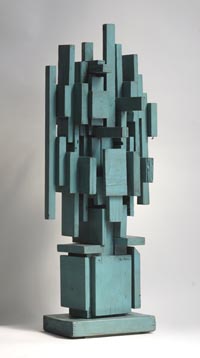
Louise Nevelson: Sculpting Her Vision of Art

"I believe in my work and the joy of it. You have to be with the work and the work has to be with you. It absorbs you totally and you absorb it totally. Everything must fall by the wayside by comparison." ~ Louise Nevelson

And in this vein Louise Nevelson led her life. Over the 88 years that she walked the earth, she worked at creating her own unique version of artwork and was absorbed by it every step of the way. Born September 23, 1899 near Kiev, Russia, Nevelson's life began in a rocky way. Her father Isaac emigrated to the United States in 1902, leaving young Nevelson and the rest of the family behind. Once he had established himself in the lumber industry in Rockland, Maine, the rest of the family relocated in 1905 to join him in the USA. While these stresses brought the family closer together in some ways, they did not make for an easy beginning for Nevelson. That was not enough to keep this up-and-coming artist down though.

Untitled - 1950
When Nevelson came across a plaster cast of Joan of Arc in the Rockland Public Library at the age of nine, she knew that art would be a part of her life forevermore. She began her art career by studying drawing in high school. In 1920, she married Charles Nevelson and moved to New York, where she further studied painting, drawing, singing, acting and dancing. From 1929-30, she studied at the Arts Student League under Kenneth Hayes Miller and Kimon Nicolaides. When her husband moved the family out of the city, she became disillusioned with marital bliss and by 1932 she separated from her husband. Recognizing the importance of this focus on herself, Nevelson flew to Europe to further explore different styles of art. While there, she studied under Hans Hofmann in Munich, as well as worked as an extra in films in Vienna and Berlin.
Sky Cathedral - 1958

Nevelson returned to the US in 1932, where she once again studied with Hofmann. She was introduced to Cubism and collage, which influenced her greatly throughout her career. The following year she met Diego Rivera and worked as an assistant to him on his "Portrait of America" murals. The further she delved into the art scene, the more she embraced a style that was all her own. She began to teach mural painting at the Works Progress Administration in 1935. Despite this, money was tight. Perhaps because of this, the materials she collected for her sculptures were often found pieces, like castoff lumber.

Royal Tide 1 - 1960
It wasn't until 1941 that Nevelson had her first solo exhibition, held at the Nierendorf Gallery. While this helped to bring attention to her Modernist sculptures, success was still slow in coming to her. By the 50s, her reputation had grown and the Museum of Modern Art purchased one of her Sky Cathedral pieces. She travelled to Latin America and the Mayan artwork she came across was soon evident in her newest creations as the decade came to an end, with gold and white taking over from her previous all black pieces.

Dawn's Landscape XXIV - 1975
Finally achieving the fame she sought, the size of her pieces grew into monumental displays. Nevelson's name became synonymous with sculpture, but she also became a figurehead in women's art as a whole. She  challenged the idea that only men could become great artists. The fact that her estate was worth over $100 million when she died in 1988, seems to support the fact that women too could crack that gender bias.


Tuesday, May 29, 2012

IN YOUR HANDS: A Focus on Sculpture

Sample Masterpiece Created
Via the Help of 2 Hands Clay
Budding Artists has a very special treat for you this weekend during our Master Series children's art workshop. Not only will we be featuring Henry Moore on Saturday, June 2, 2012, but the workshops are going to be run by our friends at 2 Hands Clay! They go to birthday parties, classrooms, into the homes of seniors, folks with special needs, and to pretty much any group that desires to play with clay (think church groups, mom & tot groups, women's groups and more), but this week they will be at the London Farmer's Market at 10:30am and 1pm sharing their clay creations with Budding Artists and a lucky group of children. How cool is that?!

Moore's creative process
So why do you think we asked 2 Hands Clay to help out with this week's children's art workshop? For those of you who suggested it was because Henry Moore was a sculptor, you'd be correct! In fact, Moore was well known for his drawings, textiles and graphics, but it was his sculptures that helped to propel him into the role of Master Artist and brought him fame around the world. Just as Budding Artists hopes your children are, he too was interested in sculpture and art from an early age. After briefly serving in World War I, Moore attended Leeds School of Art where he excelled to the point of winning a scholarship to the Royal College of Art in London in 1921.

The creative process of a child
This experience helped to start a career in the arts for Moore that we hope your own budding artists can aspire to as well. The folks at 2 Hands Clay provide the materials and a few ideas to spark some creativity, but the process is all in the hands of the creator. Just as Moore molded his creations from the influences of the world around him, as well as a vision in his mind's eye (plus a maquette or two), so too will your child, under the guidance of 2 Hands Clay, create their own masterpiece. Have clay, will create!

Reclining Figure
Moore created thousands of sculptures over his 88 years, but this weekend the process is all about your kids. Where Moore specialized in fluid forms, African motifs, female figures and family groupings, what form do you think your children will pull out of the clay? His figures were often seen reclining and featured piercings that gave an abstract air to the sculptures. Your child will have an opportunity to mold the piece of clay they receive into a form that works for them, adding colours as their creativity fancies them. With a little more encouragement, perhaps one day your child's creativity and future sculptures will grow larger, just as Moore's did when the demand for his public art commissions increased.

Only time will tell, but giving your child an opportunity to explore is the first step. What do you think your little artist can create in 90 minutes of fun and clay adventure with the help of 2 Hands Clay? Sign your kids up today and watch their vision sculpt the future. See you Saturday!

2 Hands Clay Adventure

Tuesday, April 24, 2012

Spotlight on Joan Miró

“The painting rises from the brushstrokes as a poem rises from the words. The meaning comes later.” ~ Joan Miró

Joan Miró was born April 20, 1893 in Barcelona, Spain. Son of a goldsmith mother and watch-making father, he was encouraged to go into business at an early age. Miró was drawn to the arts though. He acquiesced by attending both business school and art classes at La Escuela de la Lonja. It proved to be the art that won out though. Leaving the business world behind,  Miró continued his art lessons and was rewarded by the first solo exhibition of his works in 1918 at the Dalmau Gallery.

The Farm -1922
With a taste of the art world, Miró decided to expand his horizons and visited Paris in 1920. It was here that he met Pablo Picasso and was introduced to the Cubist movement. He also met the likes of André Masson, Pierre Reverdy and Tristan Tzara, who would come to be his friends, confidantes and influential on his artwork over the years. His earlier Fauvist style, now showed signs of these influences and by 1921, he had the first exhibit of his works in Paris, at the Galerie la Licorne.

Carnaval de Arlequin -1924
Miró was never one to settle into a rigid style though, so as time marched on, so too did his artwork. He divided his time between Paris and Spain, drawing on his Catalan roots, Fauvism, Cubism, and gradually showing an influence from Surrealism. In fact, by 1924 he joined the Surrealist group and exhibited with them at the Galerie Pierre in 1925.

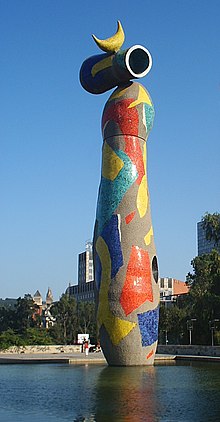
La Femme Angora - 1969
This change in style saw Miró drifting away from traditional mediums and start exploring other art forms. He began experimenting with collage on almost any surface he could get his hands on, including paper, copper and sandpaper. He tried his hand at lithography, etchings and painting other surfaces, such as stones and other found objects. He pulled away from the very idea of the frame that surrounded a painting in fact and while subject matter could still be found in his work, landscape was gone.

Dona i Ocell - 1982
While Miró embraced more sculpture and public works in his later years, he is credited with painting over 2000 oil paintings, 5000 drawings and collages, 500 sculptures and 400 ceramics. It wasn't until the 40s that he started working with ceramics, but by the 60s his focus turned to sculpture. His monumental achievements were recognized by galleries and museums around the world, including the Guggenheim.

For this reason, and so many more, he is the focus of this week's Master Series Children's Art Workshop held by Budding Artists. Join us for 90 minutes of fun, history and a dash of creativity as we explore the Surreal world and works of Joan Miró. Workshops are held at the London Farmer's Market in London, Ontario at 10:30am and 1pm. Contact Budding Artists today to reserve your child's spot!

Monday, February 6, 2012

Spotlight on Amedeo Modigliani

This week's Artist spotlight is on the tragic figure of Amedeo Modigliani. His short life spanned the years from July 12th, 1884 through January 24th, 1920. Born in Livorno, Italy, he was the son of Sephardic Jews and came from a long line of intellectual scholars. Often sickly as a child, his mother tutored him at home for much of his younger years. It wasn't until 1898 that he began his formal training with Guglielmo Micheli, under which his interest and skill flourished.

Reclining Nude
Modigliani spent two years studying the Macchiaioli style (Italian landscape movement that pre-dated the French Impressionist movement) with Micheli, before taking ill with typhoid fever, which only got worse when he developed tuberculosis. During this time he lamented the thought that he would not get the chance to see the works of the master Renaissance artists in person. His mother promised that upon his recovery she would fulfill his dreams and to her word she was good. When he sufficiently recovered, they toured through Naples, Capri, Rome, Amalfi, Florence and Venice, where young Modigliani got a new artistic lease on life. By 1902, he enrolled in the Scuola Libera di Nudo in Florence, where his real artistic passion lay - portraiture, more specifically nude portraits. After a year, he transferred to Venice, where he continued his studies, but was introduced to a life that ultimately would be his demise, that of drugs and alcohol. It seemed a natural step at that point for him to make the move to Paris and in 1906 he arrived in Montmartre.

Stone Head
Life in Paris was nothing, if not exciting. Modigliani threw himself into his art, sometimes producing upwards of a hundred sketches per day. He was heavily into drugs, alcohol and whatever other excesses he could get into, in part to mask the symptoms of his tuberculosis. After returning home in 1909 for a brief respite from his life of excess, he returned to Paris and settled in Montparnasse. It was at this point that his main focus turned to sculpture and he spent the next five years creating art out of whatever materials he could get, namely scavenged building materials from Paris's building boom. He continued to live a bohemian existence that saw him usually intoxicated and/or in the company of the women he loved to depict so often. The outbreak of World War I made building materials harder to come by though and with his worsening physical state, Modigliani returned to painting as his medium.

Jeanne Hbuterne, Left Arm Behind her Head 
During the last years of his life, Modigliani created some of his most remarkable paintings. His life of excess continued, but so too did his creativity. He created distinctive paintings of children, in part due to the fact that he had become a father himself. Jeanne Hbuterne, the mother of his daughter, moved with him to Nice, when wartime made life in Paris too difficult . They returned to Paris in 1919, but by that point Modigliani's health had deteriorated to dangerous levels. He continued to drink, do drugs and paint, but there was little to conceal his ill health. In early January 1920, Modigliani took to his bed and the doctors announced there was nothing to be done. His tuberculosis finally caught up to him, and on January 24th, 1920, the young artist died. Sadly, Hbuterne was so distraught by his death that she took her own life, and in the process, the life of her unborn child.

On Saturday February 11th, Budding Artists will take a look at this Master Artist in our Children's Art Workshops at the London Farmer's Market. Join us at 10am and 1pm, as we look at this talented artist who created incredible portraits, sculptures and more in his few short years. There will be 90 minutes of art history, games, creativity and fun, as we explore this next artist in our Masters Series - Amedeo Modigliani.