Showing posts with label post-impressionism. Show all posts

Wednesday, June 13, 2012

Spotlight on Vincent Van Gogh

Self-Portrait - 1889
Ears, shmears! Who needs them when you can paint?! Vincent Van Gogh certainly didn't. Well, at least he felt that he could do without part of his left ear, but what he could do with a paint brush was miraculous. This Post-Impressionistic painter is certainly one of the world's finest Master Artists and is the focus of this week's Budding Artists children's art workshop at the London Farmer's Market. The workshops are 90 minutes of fun, art history and a few lessons in technique in the vein of the master himself - Van Gogh. Let's take a look at what Van Gogh accomplished in his short 37 years.

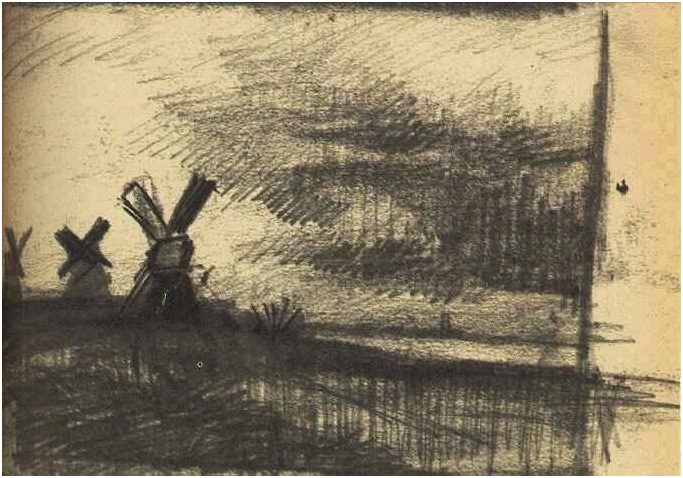
Windmills at Montmartre - 1877
Vincent Van Gogh was born in Groot-Zundert, the Netherlands on March 30, 1853. He was the son of a pastor, and hailed from a long line of artists and art dealers. He became interested in art at an early age, and flourished in Middle school when he received lessons in drawing from a successful artist there. By the time he was 20 years old, he had obtained a job as an art dealer in London, with the help from an uncle. One of the happiest periods of his short life, he sketched and drew in his extra time, when he wasn't dealing in Art. After being transferred to Paris in 1875, he fell on the outs with Goupil & Cie, the company he had been working for, and left them to return to London.

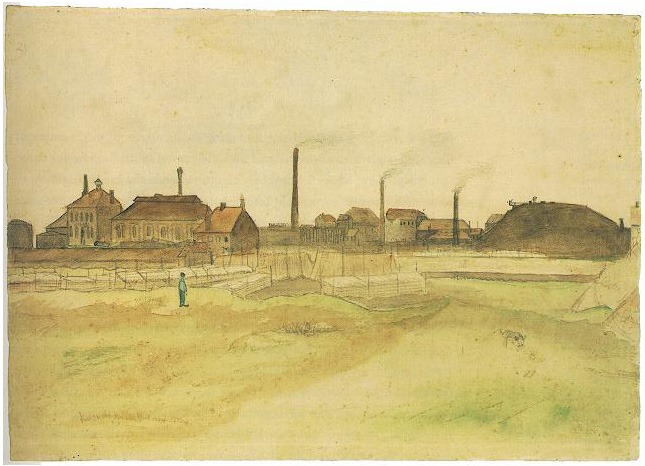
Coalmine in the Borinage - 1879
Disillusioned with the world of art dealers, Van Gogh turned to religion. He had always had a strong religious faith, but by 1876, he felt the urge to devote himself to the Church. He entered the school of theology in Amsterdam, but it quickly became apparent that he would not flourish in this path. He dropped out of school, then failed an admission test to enter a mission school in Laeken. Undeterred, he applied to a missionary post in Borinage and tried his hand at bringing religion to the people there. While his zeal was almost fanatical, the powers that be were not impressed. After only six months, they dismissed him from his post. Despite this, Van Gogh remained in the area for over a year, trying to help the residents of the impoverished area and himself, both living a life of poverty. Ultimately, via suggestions by his brother Theo, he left Borinage behind. With a failed marriage proposal to his recently-widowed cousin, he also left his religious faith as well.

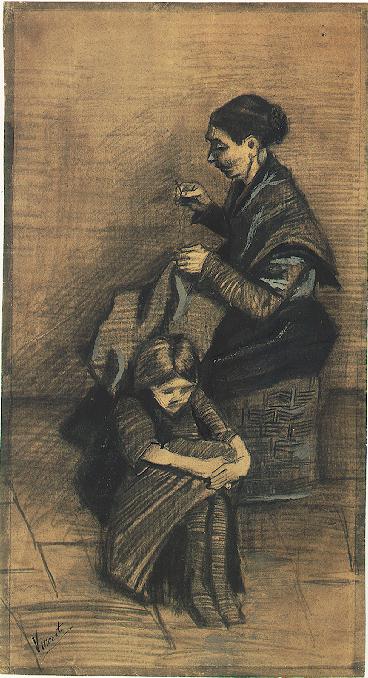
Woman Sewing,
With a Girl - 1883
It was at this point that Van Gogh reacquainted himself with his cousin Anton Mauve. Mauve introduced him to the world of watercolours and oils and ignited in him a new passion. With a career as Artist in sight, Van Gogh flung himself into this new occupation. It was at this time that he also met Clasina "Sien" Hoornik. An alcoholic, pregnant prostitute with a young daughter in tow, Van Gogh fell in love with his dear Sien. Their rocky relationship was marred by poverty and much fighting, but he was devoted to her children and often used Sien as a model. Van Gogh's family was not impressed though and they demanded he leave her. After spending three weeks in hospital, due to a case of syphilis and gonorrhea that he contracted from Sien, he was finally swayed.Van Gogh left her in 1883, after spending just over a tumultuous year together.

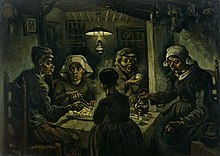
The Potato Eaters - 1885
Disheartened by another love lost, Van Gogh returned to his family's home in Nuenen and devoted himself once more to drawing and painting. He spent two years there, often-times sketching peasants. It was during this time that he painted one of his most famous works "The Potato Eaters", although it wasn't until long after his death that it received public attention. Struggling emotionally, financially, and artistically, he decided to move to Antwerp and studied the works of Peter Paul Rubens, as well as Japanese artwork. While his exploration of colour theory helped to broaden his colour palette, his locale only served to deteriorate his health. By 1886, Paris beckoned and Van Gogh moved in with his brother Theo.

Starry Night - 1889
The last few years of this troubled artist's life were incredibly productive, but also fraught with much strife. He lived with his brother Theo for most of the two years he was in Paris and during that time met the likes of Claude Monet, Camille Pissarro and of course Paul Gauguin. The bright colours that were rampant in the Impressionist movement influenced Van Gogh's own palette and suddenly his dark pieces disappeared, replaced by the bright colours that he is most famous for. The break from excess (drink, smoke, poor diet) that he hoped to achieve with a move to Arles, sadly did not improve Van Gogh's lot. While he continued to paint and draw, his health spiralled out of control. He committed himself to an asylum, but even that respite was not enough to save him. On July 27, 1890, the world lost an incredible artist, when Van Gogh shot himself in the chest. Two days later he was dead, from complications during his treatment. Despite the mental and physical illnesses that he struggled with throughout his life, he left behind a legacy of art behind. He painted nearly a thousand paintings, over a thousand drawings and sketches, as well as enough letters (mostly to his brother Theo) to document his incredible journey through life. While he only sold one painting during his lifetime, they now go for upwards of $100 million. Quite the feat, and one that has influenced a myriad of artists since then.

Perhaps its time that your child discovers the magic of this tragic master artist. See you June 16th!

Tuesday, May 1, 2012

Spotlight on Diego Rivera

Diego Rivera was born December 8, 1886 in Guanajato, Mexico. The son of school teachers, education was highly valued in his family. While attending Catholic school, he enrolled in the art program at the Academy of San Carlos. He originally attended evening classes there, but his aptitude for the arts was apparent and he became a full-time student two years later, in 1898. Rivera's first public exhibition of his work was held in 1906, which attracted enough attention that by 1907, the Governor of the State of Veracruz had sponsored Rivera to continue his studies in Europe.

Head of a Breton Woman - 1910
Rivera arrived in Europe during a time of great change in the art world. He originally studied with Eduardo Chicharra in Spain, then continued on to Paris, France. It was here that he embraced the up and coming artists of the day, including such notables as Amedeo Modigliani, Moise Kisling, Chaim Soutine, Max Jacob and gallery owner Leopold Zborowski. The Montparnasse district was full of Cubist influences, from the likes of Picasso and Georges Braque and Rivera soon found those influences affecting his own work. By 1917, the artwork of Cezanne also left an impression on Rivera and his artwork now showed signs of Post-Impressionism as well.

Creation (mural) 1922
While Europe left a huge mark on Rivera's art, his heart still belonged to Mexico and he returned to it in 1921. He had spent the past 14 years travelling throughout Spain, France and Italy, but with a more mature style, he found the need to reconnect with his home country and all that it offered. One of those things offered was the chance to leave a lasting public image via murals. At the time the government was pushing for education, equality and a recognition of their culture, which Rivera was perfect for. "Creation" was his first mural, but was just the beginning of his work with this medium, which was further showcased when he joined the Revolutionary Union of Technical Workers, Painters and Sculptors. He followed that up by joining the Mexican Communist Party later that year.

El Vendedor De Alcatraces
His association with the Communist Party was not an easy one though. Rivera was vocal in his political beliefs and often attacked the church and clergy, making him a controversial figure. Despite that, he was invited to visit Russia in 1927. After spending nine months there, he was asked to leave and left with very little to show for his time spent, aside from a few paintings and much disillusionment on both sides about the other parties. Non-plussed, Rivera continued to paint, this time embracing another land and culture, that of the United States.

Section of Detroit Industry - 1933
In 1930, Rivera arrived in San Francisco with his new wife Frida Khalo. The architect Timothy L. Pflueger had heard about Rivera from Ralph Stackpole and subsequently had encouraged him to paint for him in the USA. This proved a successful venture for Rivera and he painted many murals, including "Detroit Industry" at the Detroit Institute of Arts. He spent three years in the US, then returned to Mexico, after furors over his political beliefs. He returned once more in 1940, again by request of Pflueger, this time to paint for the Golden Gate International Exposition.

Over the span of Rivera's lifetime, he created many murals and many more controversies. He had many affairs, often torrid in nature, but his love for Khalo was the one constant at the end of his life. His relations with the Communist Party waxed and waned, but shortly before his death he was allowed to re-establish ties to the party. His beliefs affronted many, but his skill impressed more. And Budding Artists recognizes everything that he accomplished and will be featuring him in this weekend's Master Series Children's Art Workshop. So pack up your kids and ship them off to the London Farmer's Market on Saturday May 5th at 10:30am or 1pm, where they will enjoy 90 minutes of creativity, art history and fun with Budding Artists and famed Mexican artist Diego Rivera. A perfect activity for them to celebrate art and Cinco de Mayo too!

Monday, January 30, 2012

Spotlight on Henri Rousseau

Self Portrait Of The Artist With A Lamp
Today, Budding Artists is thrilled to introduce Henri Rousseau. This French Post-Impressionist painter was born May 21st, 1844 in Laval, France. He was the son of a tinsmith and familiar with hard economic times during his early years. After the death of his father in 1868, he moved to Paris and became a government official. His position as tax collector enabled him to support his widowed mother,wife, family of six children and himself, although it left little time for artistic endeavors. In fact, it wasn't until he was in his forties that he turned to painting as a form of expression.

Sleeping Gypsy
So when Rousseau did finally embrace the life of a painter at the turn of the twentieth century, he came to it without any of the formal training that so many of his peers enjoyed at that time.  Hence, while he displayed many of his paintings in the Salon des Independants, he was often the focus of regular criticisms from the artists of the day. There were many that considered his artwork primitive and naive, but that did not prevent him from creating over 100 paintings, as well as influencing a whole new generation of artists.

The Snake Charmer
In fact, Pablo Picasso was said to have come across some of Rousseau's paintings being sold on the street, only to seek out the artist to meet with the genius behind them. Rousseau was also commissioned by artist Robert Delaunay's mother to paint "The Snake Charmer". And it seemed more than chance that his paintings were displayed near Matisse in what has since become known as the first showing of the "Fauves".

Tiger in a Tropical Storm Surprised
Throughout Rousseau's career, jungle scenes often dominated his canvases. This coming Saturday, February 4th Budding Artists will look at these scenes and many others to get a better look at the style and skill of this Post-Impressionistic painter. Through 90 minutes of games, art history and hands on practice, we will be running the next in our Masters Series of Kids Art Workshops at the Western Fair Farmer's Market at 10am and 1pm. Contact us today to book a space for your child to explore this vanguard artist.

Monday, January 16, 2012

Spotlight on Emily Carr

Emily Carr was born in Victoria, British Columbia on December 13th, 1871. She grew up on beautiful Vancouver Island, on the Western edge of Canada, surrounded by mountains, the ocean, trees and a proper English upbringing by her parents Richard and Emily Saunders Carr. The second youngest of six children, she struggled to keep up with her parent's strict religious teachings, instead preferring to  dabble in her artistic interests.

Autumn Woods 1911
It wasn't until after Carr's parents passed away that she was able to truly delve into her artistic passion. She attended the San Francisco Art Institute from 1890-1892, then returned to her beloved Vancouver Island. The landscape around here and the native people who dwelt there would prove to be a powerful influence to her art from early on. It was not just simple landscape prints that she was creating though. She was drawn to the spirit of the peoples and the land that they shared. Her first trip up the Western coast would have a profound effect on her artwork for the rest of her life.

Skedans
In 1899, she travelled to London, England to attend the Westminster School of Art. She returned to Canada in 1904 a little wiser, but still feeling like there was something that she was missing in the watercolour paintings she was creating. By 1910, she returned to Europe, this time heading to Paris and an art scene that held the likes of Picasso, Braque, Cubism, Post Impressionism and Fauvism. She studied at the Académie Colarossi and met Harry Gibb, who had a large effect on her vision and style. She returned to British Columbia in 1912 with a new vision and a much brighter colour palette in her paintings.

Indian Church
Sadly, her vision and painting became dormant upon returning home. She spent the next 15 years running a boarding house and the lack of a modern art scene on the West Coast left her disillusioned. It wasn't until 1927, when she was contacted by the National Gallery of Canada to participate in an exhibit of West Coast Aboriginal art that her artistic career came to life again. She was introduced to members of the Group of Seven and quickly became an honorary member. In fact, Lawren Harris became a mentor, supporter and dear friend that reinvigorated her painting and spirit of life.

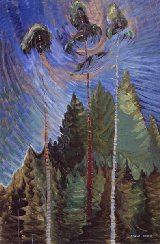
Odds & Ends
Carr's renewed interest in art spurred the vast majority of her recognized pieces today. Totem Poles, trees and Native scenes dominated her canvasses throughout her career, but never more prevalently than during this period. Her mediums spanned charcoal, watercolour, oils and even ran to the written word with several books published in the last few years of her life. On March  2nd, 1945 Carr passed away, but not before leaving her mark on the Canadian art scene, as well as on the world stage of post-impressionistic art.