Monday, February 6, 2012

Spotlight on Amedeo Modigliani

This week's Artist spotlight is on the tragic figure of Amedeo Modigliani. His short life spanned the years from July 12th, 1884 through January 24th, 1920. Born in Livorno, Italy, he was the son of Sephardic Jews and came from a long line of intellectual scholars. Often sickly as a child, his mother tutored him at home for much of his younger years. It wasn't until 1898 that he began his formal training with Guglielmo Micheli, under which his interest and skill flourished.

Reclining Nude
Modigliani spent two years studying the Macchiaioli style (Italian landscape movement that pre-dated the French Impressionist movement) with Micheli, before taking ill with typhoid fever, which only got worse when he developed tuberculosis. During this time he lamented the thought that he would not get the chance to see the works of the master Renaissance artists in person. His mother promised that upon his recovery she would fulfill his dreams and to her word she was good. When he sufficiently recovered, they toured through Naples, Capri, Rome, Amalfi, Florence and Venice, where young Modigliani got a new artistic lease on life. By 1902, he enrolled in the Scuola Libera di Nudo in Florence, where his real artistic passion lay - portraiture, more specifically nude portraits. After a year, he transferred to Venice, where he continued his studies, but was introduced to a life that ultimately would be his demise, that of drugs and alcohol. It seemed a natural step at that point for him to make the move to Paris and in 1906 he arrived in Montmartre.

Stone Head
Life in Paris was nothing, if not exciting. Modigliani threw himself into his art, sometimes producing upwards of a hundred sketches per day. He was heavily into drugs, alcohol and whatever other excesses he could get into, in part to mask the symptoms of his tuberculosis. After returning home in 1909 for a brief respite from his life of excess, he returned to Paris and settled in Montparnasse. It was at this point that his main focus turned to sculpture and he spent the next five years creating art out of whatever materials he could get, namely scavenged building materials from Paris's building boom. He continued to live a bohemian existence that saw him usually intoxicated and/or in the company of the women he loved to depict so often. The outbreak of World War I made building materials harder to come by though and with his worsening physical state, Modigliani returned to painting as his medium.

Jeanne Hbuterne, Left Arm Behind her Head 
During the last years of his life, Modigliani created some of his most remarkable paintings. His life of excess continued, but so too did his creativity. He created distinctive paintings of children, in part due to the fact that he had become a father himself. Jeanne Hbuterne, the mother of his daughter, moved with him to Nice, when wartime made life in Paris too difficult . They returned to Paris in 1919, but by that point Modigliani's health had deteriorated to dangerous levels. He continued to drink, do drugs and paint, but there was little to conceal his ill health. In early January 1920, Modigliani took to his bed and the doctors announced there was nothing to be done. His tuberculosis finally caught up to him, and on January 24th, 1920, the young artist died. Sadly, Hbuterne was so distraught by his death that she took her own life, and in the process, the life of her unborn child.

On Saturday February 11th, Budding Artists will take a look at this Master Artist in our Children's Art Workshops at the London Farmer's Market. Join us at 10am and 1pm, as we look at this talented artist who created incredible portraits, sculptures and more in his few short years. There will be 90 minutes of art history, games, creativity and fun, as we explore this next artist in our Masters Series - Amedeo Modigliani.

Monday, January 30, 2012

Spotlight on Henri Rousseau

Self Portrait Of The Artist With A Lamp
Today, Budding Artists is thrilled to introduce Henri Rousseau. This French Post-Impressionist painter was born May 21st, 1844 in Laval, France. He was the son of a tinsmith and familiar with hard economic times during his early years. After the death of his father in 1868, he moved to Paris and became a government official. His position as tax collector enabled him to support his widowed mother,wife, family of six children and himself, although it left little time for artistic endeavors. In fact, it wasn't until he was in his forties that he turned to painting as a form of expression.

Sleeping Gypsy
So when Rousseau did finally embrace the life of a painter at the turn of the twentieth century, he came to it without any of the formal training that so many of his peers enjoyed at that time.  Hence, while he displayed many of his paintings in the Salon des Independants, he was often the focus of regular criticisms from the artists of the day. There were many that considered his artwork primitive and naive, but that did not prevent him from creating over 100 paintings, as well as influencing a whole new generation of artists.

The Snake Charmer
In fact, Pablo Picasso was said to have come across some of Rousseau's paintings being sold on the street, only to seek out the artist to meet with the genius behind them. Rousseau was also commissioned by artist Robert Delaunay's mother to paint "The Snake Charmer". And it seemed more than chance that his paintings were displayed near Matisse in what has since become known as the first showing of the "Fauves".

Tiger in a Tropical Storm Surprised
Throughout Rousseau's career, jungle scenes often dominated his canvases. This coming Saturday, February 4th Budding Artists will look at these scenes and many others to get a better look at the style and skill of this Post-Impressionistic painter. Through 90 minutes of games, art history and hands on practice, we will be running the next in our Masters Series of Kids Art Workshops at the Western Fair Farmer's Market at 10am and 1pm. Contact us today to book a space for your child to explore this vanguard artist.

Sunday, January 29, 2012

Group of Seven Artwork

During our Crafting the Masters workshop this past weekend, our young artists created artwork in the style of the Group of Seven. We focussed on landscapes and we used coloured tape to create masterpieces. We didn't have all the colours needed so we used sharpies and coloured regular masking tape. I think the kids did an awesome job!


Monday, January 23, 2012

Spotlight on The Group Of Seven

Algoma Sketch II - Lawren Harris


It is almost impossible to think of the Canadian art scene and not immediately have the Group Of Seven come to mind. Iconic images of the Canadian landscape form the backdrop to this incredibly successful group of artists that changed the face of art and Canadian's place in it. In fact, the Group of Seven heralded Canada's first National art scene via the creativity from seven Canadian painters that are still cherished to this day. And who were the first members of this distinguished group? None other than Franklin Carmichael, Lawren Harris, A.Y. Jackson, Franz Johnston, J.E.H. MacDonald, Arthur Lismer and Frederick Varley.


Autumn Foliage - Tom Thomson
The founding gentlemen of the Group of Seven began to meet around 1913 in Toronto, Ontario. Another artist by the name of Tom Thomson joined these original members in discussing their painting and art theories. They began to meet at a studio in Rosedale and travelled throughout Ontario sketching landscapes. Algonquin Park, Algoma and the Muskoka region were favourite locations and inspired the vast majority of the artist's brushes. Sadly in 1917, Thomson died in a mysterious accident doing one of the things that he loved best: canoeing in Algonquin Park.


The White Pine - A.J. Casson
While this loss, along with the disruption from World War I, temporarily prevented the group from moving forward, the artists were not deterred. They reunited after the war and by 1920 officially labelled themselves as the "Group of Seven" and launched their first public exhibition. With the unwavering support from the National Gallery, these fresh new artists challenged the art scene of the day, introducing hitherto unfashionable landscape scenes. It was also at this time that Frank Johnston left the group, to be replaced by A.J. Casson.


Northern Tundra - Franklin Carmichael
Over the next decade, the Group of Seven gained in strength and breadth. They expanded their inspiration area, moving into landscapes across Canada from British Columbia to Quebec, Nova Scotia and even the Arctic. Their influence permeated the Canadian art scene and drew attention from other artists such as Emily Carr, Edwin Holgate and LeMoine Fitzgerald. By 1932, the members felt that it was no longer necessary to continue as a group and formerly disbanded. A new group, called the Canadian Group of Painters, was formed encompassing a wider range of artists, but still maintained the Group of Seven's original appeal and skill.


The Red Maple - A.Y. Jackson
Over the 13 years that the Group of Seven existed, this collection of intrepid artists challenged a fledgling art scene of a new nation. Where landscapes had previously been disparaged by Canadians, these forward thinking painters rebelled against the conservative art scene that previously had its focus on imitating other art styles. They took the Canadian landscape and pushed it into a revered spot, where nature was the ultimate canvas. Their influence to the Canadian art scene was so complete, that today they are considered the pinnacle of the Canadian image and examples of their paintings can be found in almost every art gallery across the country.


A September Gale Georgian Bay - Arthur Lismur
This coming weekend, Budding Artists will be taking an indepth look at the style and colours that helped to define these landscape artists as distinctly Canadian. Join us Saturday January 28th at 10am or 1pm for 90 minutes of art history, games, and fun at the Western Fair Farmer's Market, as we focus on the distinctly Canadian style from our Master Artists of the week: the Group of Seven.

Call today to book your child's spot!

Monday, January 16, 2012

Spotlight on Emily Carr

Emily Carr was born in Victoria, British Columbia on December 13th, 1871. She grew up on beautiful Vancouver Island, on the Western edge of Canada, surrounded by mountains, the ocean, trees and a proper English upbringing by her parents Richard and Emily Saunders Carr. The second youngest of six children, she struggled to keep up with her parent's strict religious teachings, instead preferring to  dabble in her artistic interests.

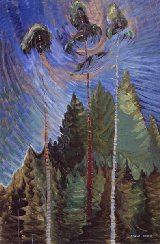
Autumn Woods 1911
It wasn't until after Carr's parents passed away that she was able to truly delve into her artistic passion. She attended the San Francisco Art Institute from 1890-1892, then returned to her beloved Vancouver Island. The landscape around here and the native people who dwelt there would prove to be a powerful influence to her art from early on. It was not just simple landscape prints that she was creating though. She was drawn to the spirit of the peoples and the land that they shared. Her first trip up the Western coast would have a profound effect on her artwork for the rest of her life.

Skedans
In 1899, she travelled to London, England to attend the Westminster School of Art. She returned to Canada in 1904 a little wiser, but still feeling like there was something that she was missing in the watercolour paintings she was creating. By 1910, she returned to Europe, this time heading to Paris and an art scene that held the likes of Picasso, Braque, Cubism, Post Impressionism and Fauvism. She studied at the Académie Colarossi and met Harry Gibb, who had a large effect on her vision and style. She returned to British Columbia in 1912 with a new vision and a much brighter colour palette in her paintings.

Indian Church
Sadly, her vision and painting became dormant upon returning home. She spent the next 15 years running a boarding house and the lack of a modern art scene on the West Coast left her disillusioned. It wasn't until 1927, when she was contacted by the National Gallery of Canada to participate in an exhibit of West Coast Aboriginal art that her artistic career came to life again. She was introduced to members of the Group of Seven and quickly became an honorary member. In fact, Lawren Harris became a mentor, supporter and dear friend that reinvigorated her painting and spirit of life.

Odds & Ends
Carr's renewed interest in art spurred the vast majority of her recognized pieces today. Totem Poles, trees and Native scenes dominated her canvasses throughout her career, but never more prevalently than during this period. Her mediums spanned charcoal, watercolour, oils and even ran to the written word with several books published in the last few years of her life. On March  2nd, 1945 Carr passed away, but not before leaving her mark on the Canadian art scene, as well as on the world stage of post-impressionistic art.

Tuesday, November 8, 2011

Spotlight on Salvador Dali

"Have no fear of perfection, you'll never reach it."

So said Salvador Dali, but he did manage to find a great measure of fame for his Surrealist artwork, as well as his eccentric ways. The mustachioed Dali was a bold and flamboyant character that produced over 1500 paintings over the course of his career. He also dabbled in drawing, sculpture, book illustrations, lithographs, as well as theatre sets and costume design, all of which captured his surrealist stylings.

Salvador Dali was born May 11, 1904 in Figueres, Spain. From a young age, he displayed artistic skill, which his Mother encouraged, despite his strict Father's disciplinary ways. None the less, young Dali was sent to San Fernando Academy of Fine Arts in Madrid, where he began to further develop his artistic talents. His skill quickly caught the eye of Spaniards and he had his first public exhibition of his work in 1919. Much to Dali's chagrin though, his Mother died in 1921, unable to watch her son's rise to fame over the years to come.

The Persistence of Memory - 1931
And rise to fame he did. In 1924, he illustrated his first book, for Carles Fages de Climent ("Les bruixes de Llers"). He was expelled from the Academy in 1926, for instigating unrest amongst students, but that did not prevent him from meeting Pablo Picasso, who had already heard of this up and coming artist. By 1929, he collaborated with Luis Buñuel, a surrealist film director on a short film entitled "Un Chien Andalou". This was also the year that he met Elena Ivanovna Diakonova, or as he fondly called her, Gala. Despite the fact that she was married to Surrealist poet Paul Éluard, they began a torrid love affair that eventually led to their marriage in 1934.

Les Elephants - 1948
While Dali had worked in a surrealist style for a number of years, it wasn't until 1929 that he officially joined the Surrealist group, led by Dadaist Andre Breton. He became the leader of the Surrealists shortly thereafter, but in 1934 was kicked out of the group, via a trial of his peers, in chief point because he clashed with their political beliefs. This did not deter Dali though and he continued to show his works at Surrealist exhibitions around Europe. The outbreak of World War II, saw himself and Gala flee to the US though, where he continued to enjoy a measure of fame. He had an exhibition at the Museum of Modern Art in New York in 1941 and went on to publish his autobiography in 1942. He and Gala stayed in the United States until after the war, returning to Catalonia, Spain in 1949.

Salvador Dali’s Chupa Chups logo
Chupa Chups Logo - 1969
With his return to Spain, Dali began to move in a new direction with his art, entering a Classical period. He explored science, religion and even delved into the world of optical illusions. All the while, he worked for such notables as Walt Disney, Gabrielle "Coco" Chanel, Edward Jones, Alfred Hitchcock and fashion designers Elsa Schiaparelli  and Christian Dior. He even designed the logo for Chupa Chups in 1969, that is still in use today.

The loss of his beloved Gala in 1982, foreshadowed Dali's own decline. He continued to work, but ultimately after suffering heart failure on January 23, 1989, Salvador Dali passed away at the age of 84.

"The problem with the youth of today' is that one is no longer part of it."

Ah, but for the children out there, Dali is not lost. This weekend, Budding Artists will be featuring Dali in our Children's Art Workshop at the Western Fair Farmer's Market. Our workshops are 90 minutes, and jam-packed full of art history, games, stories and of course an opportunity to create your own Dali-inspired artwork to take home with you. Call Budding Artists today to register for either the 10am or 1pm workshop and have your children experience the thrill and surreal world of Salvador Dali. See you on November 12th!

Tuesday, November 1, 2011

"Everything Starts From A Dot"

Kandinsky
This coming weekend, Budding Artists featured artist of the week for our Children's Art Workshop is Wassily Kandinsky. Kandindsky was an abstract painter that lived from Dec. 16, 1866 to Dec 13, 1944. He was far more than just a painter though. Kandinsky delved into the world of form and colour and made it his own. He also was an important art theorist in his day, forming several art groups, the most famous of which was "The Blue Rider". Over the course of his artistic career, he worked through a variety of styles including colourful landscapes in his earlier years, to geometric depictions with a focus on point and lines, and finally to a complete embrace of  'abstract art' where emotion and spirituality were born and as he describes,

"Everything starts from a dot."  Kandinsky

Source: flickr.com via steena on Pinterest

So starting with that dot and some inspiration found on Pinterest, I thought we could explore some art work that speaks in Kandinsky's art styles today. Shown here are some "Autumn Trees" that would please any budding artist's sense of colour, and incidentally what Kandinsky was a master at.

The Crafty Crow showcased a great collaborative style mural that would be great for any art class to attempt. Just add lots of paint, encourage a wee bit of colour mixing and see what comes out of this art project. Once individual squares are all attached together, you will have an art project that everyone will appreciate.


Source: riversoftheworld.org via Sarah on Pinterest

And if this doesn't scream Kandinsky, then I don't know what does. This clever display is done via felt making! Hmm, another medium to explore.


Or if you'd rather explore 3-D art, then take a look at this beautiful mural done by some primary aged pupils at a Boston school. That is a masterpiece that would be a proud addition to any school hallway, in my humble opinion.


So how do you start with a dot? What does your circle represent? Share some of your favourite Kandinsky inspired artwork with us!