Tuesday, October 4, 2011
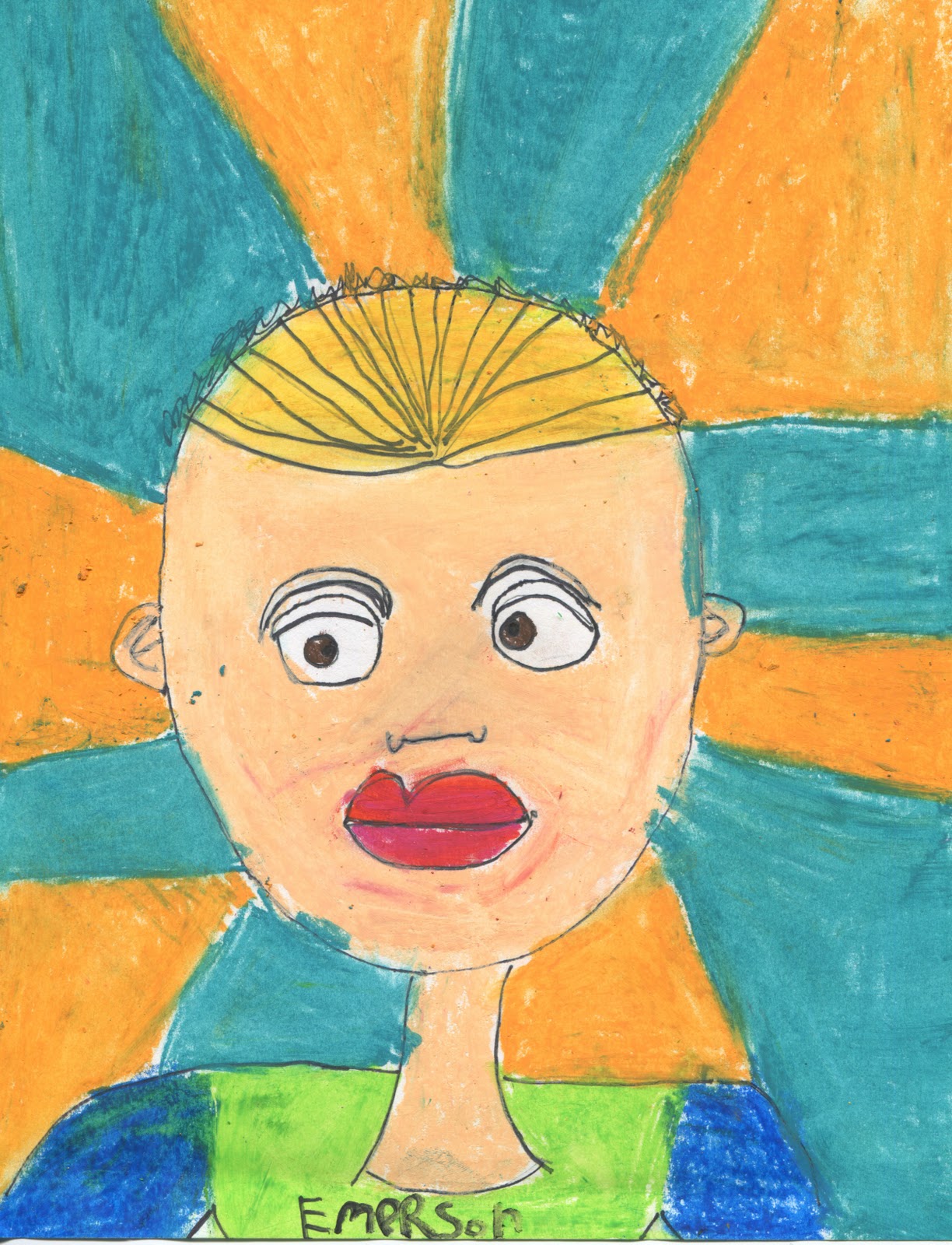
Self Portraits
Here are self portraits created by the participants of the Da Vinci workshop. We looked at the Mona Lisa and discussed facial proportions. The kids used pastel.
Tuesday, September 27, 2011
Spotlight on Leonardo Da Vinci
Leonardo Da Vinci was born on April 15th, 1452 in Vinci, just outside of Florence, Italy. He was the illegitimate son of Ser Piero, a legal notary, and a peasant girl by the name of Caterina. Despite his illegitimacy, Da Vinci spent much of his youth in his father's care. It was there that he was introduced to scholarly texts and the beginnings of his informal education. At the age of 15, he was apprenticed by his father to Andrea del Verrocchio, a famous local artist that had seen the likes of Botticelli, Perugino and Domenico Ghirlandaio associated with his workshop. It was there that he received more formal training, that would have included, among other things, drafting, metallurgy, leather working, as well as drawing, painting and sculpting. It was also during this time that he was accepted into the famous Guild of St Luke, which was an artist guild in Florence. He continued to work out of the Verrocchio workshop until 1477, at which time he struck out on his own.
Da Vinci continued to work in Florence until 1482 when he relocated to Milan. In Milan, He found employment with Duke Ludovico Sforza, where he was commissioned to create paintings, bronze sculptures, draw up architectural plans, as well as to design military equipment and even floats for parades. It was during his 17 years in Milan that he painted "The Last Supper" for the monastery of Santa Maria delle Grazie, which subsequently became one of his most famous paintings.When the French invaded Milan and overthrew the Duke, Da Vinci fled back to Florence, leaving behind him a fantastic period of creativity that spanned much scientific research, many weaponry designs, the study of geometry, mechanics, municipal construction, and perhaps even the first conceived helicopter. With his attention divided between so many interests, he found it hard to focus on any one thing, but between frequent forays into nature, meticulous transcribing of his studies of anatomy, painting, mechanics and architecture in several journals, he also managed to paint "The Virgin on the Rocks".
In 1502, Da Vinci gained employment with Pope Alexander the VI's son, Cesare Borgia. He travelled extensively around Italy as a Senior Military Architect and General Engineer, where he surveyed cities and sketched some of the first maps available. By 1503, he moved back to Florence and rejoined the Guild of St Luke. It is also believed that during that year, he began work on his most famous painting, the Mona Lisa. It is with this painting that he established "Sfumato", which was a style of painting that used a shadowy quality that he became well known for.
Between 1506-1508, Da Vinci moved between Florence and Milan, focusing mostly on his study of anatomy and architecture. By 1513, he moved to Rome, where he was offered a home at the Vatican, by his good friend Giuliano de'Medici. He stayed there until 1516, when the King of France, Francis I, offered him the position of First Painter, Architect and Engineer to the King. The famed Renaissance Painter left behind Italy, never to return again. He died on May 2nd, 1519.
While Da Vinci is lauded as a brilliant painter, he is equally as well known for his drawings, inventions, journals, scientific studies, engineering and anatomical understandings. All of these pursuits helped to better hone his skills, which established him as a master in many things in his day and beyond. In fact, his width and breadth of knowledge is obviously noted in his ability to capture the human form, as well as mastering the art of the "vanishing point" (ability to capture depth and three-dimensionality).
On October 1st, 2011, at the Western Fair Farmer's Market, children aged 5-12 years will get the chance to learn more about Leonardo Da Vinci through the use of games, stories and art history lessons with the folks from Budding Artists. In a 90-minute workshop, children will learn basic art techniques and be able to take home a masterpiece of their own making, based on the styling of this famous Renaissance Painter. This is the second in a course of workshops that will feature a new master artist every week. If you think your little budding artist could use some helpful hints or new techniques, register them now! You will find us on the second floor ready to get creative and have fun. See you there!
![]() |
| The Last Supper |
![]() |
| Mona Lisa |
Between 1506-1508, Da Vinci moved between Florence and Milan, focusing mostly on his study of anatomy and architecture. By 1513, he moved to Rome, where he was offered a home at the Vatican, by his good friend Giuliano de'Medici. He stayed there until 1516, when the King of France, Francis I, offered him the position of First Painter, Architect and Engineer to the King. The famed Renaissance Painter left behind Italy, never to return again. He died on May 2nd, 1519.
![]() |
| "The Vitruvian Man" |
On October 1st, 2011, at the Western Fair Farmer's Market, children aged 5-12 years will get the chance to learn more about Leonardo Da Vinci through the use of games, stories and art history lessons with the folks from Budding Artists. In a 90-minute workshop, children will learn basic art techniques and be able to take home a masterpiece of their own making, based on the styling of this famous Renaissance Painter. This is the second in a course of workshops that will feature a new master artist every week. If you think your little budding artist could use some helpful hints or new techniques, register them now! You will find us on the second floor ready to get creative and have fun. See you there!
Labels:
artist,
Budding Artists,
kids art,
Leonardo Da Vinci,
Sfumato,
vanishing point
Tuesday, September 20, 2011
Spotlight on Pablo Picasso
MEET PABLO PICASSO
Pablo Picasso was born in Malaga, Spain on October 25th, 1881 to Don José Ruiz y Blasco and María Picasso y Lópe. In fact, his legal name was Pablo Diego José Francisco de Paula Juan Nepomuceno María de los Remedios Cipriano de la Santísima Trinidad Ruiz y Picasso, honouring several saints and relatives, which was typical of his Spanish heritage. While his lengthy name is remarkable, this incredible man went on to be one of the founding members of the Cubist movement and one of the most renowned artists of the 20th century.LIFE AND TIMES: The Early Years
![]() |
| Couple in Cafe - 1903 |
While Paris may have been the Art Capitol of Europe, it did nothing for Picasso's financial status in the early years. He was said to have burned many of his paintings just to keep warm during his "Blue Period" that lasted from 1901-1904. Not surprisingly, much of the art work that he created during that time was related to poverty and forms of melancholy. The dominant colour palette was in shades of blue and blue-green, a darkness that perhaps reflected the world around him.
![]() |
| La Famille Acrobate au Singe |
MATURE STYLES & CUBISM
![]() |
| Ma Jolie |
By 1909, Picasso was entering his Analytic Cubism period. It was characterized by monochromatic colour palettes with a heavy use of brown, but more importantly, featured objects in terms of their analytic shapes. As he morphed into Synthetic Cubism in 1912, the use of cut paper fragments dominated his style forming the collage-type images that he is now best known for. This period grew and developed until after the First World War, when Picasso again took his art in another direction. By the 1920s, his work featured many graphic and often grotesque nudes that had many describing his work as a forerunner of Surrealism.
THE LATER YEARS
Not content to settle on any one style, Picasso continued to develop his mediums. By the 1950s, he was experimenting with reinterpreting paintings by other artists such as Goya, Manet, Delacroix and Velazquez. He was also heavily into sculpture, ceramics, copperplate etchings and drawings. By the time he died in 1973, it is estimated that he produced over 50,000 pieces of artwork, making him one of the most prolific and well-known artists of his day. While he can be said to have been influenced by Gertrude Stein, Toulouse-Lautrec, Matisse and Cézanne, Picasso's sphere of influence is much harder to define. You can see his effects in such varied artists as Jackson Pollock, Willem de Kooning, Juan Gris, Lee Krasner and of course any Cubist artists that followed him. With individual pieces of his artwork selling for over $100 million dollars each, it would seem that his fame is here to stay and that the appreciation for it is alive and well.PICASSO AND BUDDING ARTISTS
Budding Artists is well aware of Pablo Picasso's fame and influence. We admire his variety of mediums, as well as the scope of his work. That is why, on Saturday September 24th, 2011, we will be focusing on Pablo Picasso during our first art workshop of the season at the Western Fair's Farmer's Market. The 90-minute workshop will contain art history through games, stories and cool art projects that your Budding Artists will create and take home at the end of the day. Geared for 5-12 year olds, they will be sure to have a lot of fun and perhaps discover a new medium that speaks to them. If Picasso could explore so many styles over his lifetime, imagine what your child could accomplish in theirs.*Written By Katherine Krige
Tuesday, September 13, 2011
It has been long time since I posted. It was a busy summer with a good balance between time spent with my family and friends and working on Budding Artists. For the first time, my friend Nancy and I organized two art camps out of her studio and backyard. We had a dozen awesome kids. It was so enjoyable. We focussed on one master artist a day.
Inspired by Van Gogh, The Bedroom
Inspired by Van Gogh's "Starry Night" made by Grade 1s
Sculptures inspired by Giacometti's Walking Man
Pillowcases inspired design of Freidenreich Hundertwasser
Thursday, July 14, 2011
Tissue Paper Painting
A few weeks ago, I was perusing the Dick Blick's art lessons and came across this lesson Its called No Blender Pulp Painting. I was looking for a grade 1 lesson and this seemed appropriate. I had all the materials: no bleed tissue paper, water, canvas and that's it. I designed a simple picture of trees and a sun on a canvas. At the time, I only had blue, brown, green and yellow tissue paper.I cut up the tissue paper into squares. Kids dipped and placed the wet tissue paper onto the canvas. The hardest part was waiting for our masterpiece to dry.
My 8 year old daughter and her 3 year old and 5 year old cousins enjoyed making the painting together. It was super easy and an activity that spans age groups. A
Friday, May 6, 2011
Artwork Inspired by Robert Delauny
I teach occasionally in various schools in London, Ontario. One day, I was at Wilton Grove and I replaced Deb Bennett. Her students had done an amazing job on their artwork inspired by Robert Dulauny's Rhythm, Joie de Vivre. Here is a video on their work.
I told her that I could use their designs and create keepsake candles- a perfect gift for Mother's Day. The artwork was originally done on 11x17 paper. I asked her to fold the paper into an 8.5 x11 size in order to scan. After I scanned it, You should print as mirror image. I printed it on laser waterslide paper.
I gave each printed image to each student and they had to trim it to the edge. I showed them how to do put the image on the candle but I did each one. Its a little tricky and I didn't want disappointed students.
I placed the image in lukewarm water for 30 seconds. I added glue using a glue stick on the candle and then slipped off the water slide image onto the candle. I didn't have my camera at the time so I am hoping Deb was able to take pictures of the finished product. Kids loved it and couldn't wait to give it to their mothers.
I told her that I could use their designs and create keepsake candles- a perfect gift for Mother's Day. The artwork was originally done on 11x17 paper. I asked her to fold the paper into an 8.5 x11 size in order to scan. After I scanned it, You should print as mirror image. I printed it on laser waterslide paper.
I gave each printed image to each student and they had to trim it to the edge. I showed them how to do put the image on the candle but I did each one. Its a little tricky and I didn't want disappointed students.
I placed the image in lukewarm water for 30 seconds. I added glue using a glue stick on the candle and then slipped off the water slide image onto the candle. I didn't have my camera at the time so I am hoping Deb was able to take pictures of the finished product. Kids loved it and couldn't wait to give it to their mothers.
Wednesday, May 4, 2011
Artwork inspired by George Seurat using texture rubbings
A few weeks I attended an art workshop for occasional teachers. It was put on by the Thames Valley District School Board and held at Althouse at UWO in London, Ontario. It was fantastic for many reasons...The main reason was that I was paid to attend the workshop as part of my professional development as an occasional teacher. I got some great ideas and for the first time played around with wax to create encaustic paintings.
While there, I had an "aha" moment. Whenever I facilitate an art workshop on artwork by George Seurat, we make a dot art painting using cotton swabs. Kids usually love this activity. I have learned over the years that the size of the paper will depends on the age of the child. So as a rule, the older the child is, the larger the canvas or else use bingo dabbers for the younger children. Kids lose interest easily.
Back to my "aha"moment. We were creating textured artwork when I realized that kids could use school walls ( as long as they are made of concrete cylinder blocks like some of the schools, I visit) to create dotted art. By rubbing the walls, you get a "dotted" look. If you combine it with different colours, it gives the picture more depth.
Today, I had the students create their pictures directly on the wall. Here are some samples:

My other "aha" moment was today when I was taking the paper off the crayons. It was time consuming and boring. I wished I had rock crayons from Clementine Art. (We sell these at the Western fair market and our website.) They come in a set of 12 and are easy to hold for making rubbings. . They are perfect for small hands and the pigments are rich. From now on I am putting a set of these crayons in my occasional teaching art survival kit!
While there, I had an "aha" moment. Whenever I facilitate an art workshop on artwork by George Seurat, we make a dot art painting using cotton swabs. Kids usually love this activity. I have learned over the years that the size of the paper will depends on the age of the child. So as a rule, the older the child is, the larger the canvas or else use bingo dabbers for the younger children. Kids lose interest easily.
Back to my "aha"moment. We were creating textured artwork when I realized that kids could use school walls ( as long as they are made of concrete cylinder blocks like some of the schools, I visit) to create dotted art. By rubbing the walls, you get a "dotted" look. If you combine it with different colours, it gives the picture more depth.
Today, I had the students create their pictures directly on the wall. Here are some samples:

My other "aha" moment was today when I was taking the paper off the crayons. It was time consuming and boring. I wished I had rock crayons from Clementine Art. (We sell these at the Western fair market and our website.) They come in a set of 12 and are easy to hold for making rubbings. . They are perfect for small hands and the pigments are rich. From now on I am putting a set of these crayons in my occasional teaching art survival kit!
Subscribe to:
Comments (Atom)


